
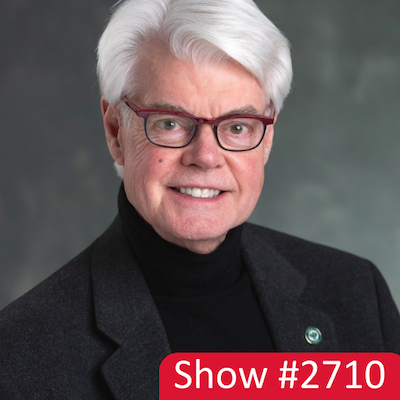
23 Dec December 23, 2025 – Former Skidmore Pres. Dr. Philip A. Glotzbach and Go Giver Bob Burg
Transcript
0:04 Intro
Broadcasting from AM and FM stations around the country. Welcome to the Small Business Administration award-winning School for Startups Radio, where we talk all things small business and entrepreneurship. Now, here is your host, the guy who believes anyone can be a successful entrepreneur, because entrepreneurship is not about creativity, risk, or passion: Jim Beach.
0:26 Jim Beach
Hello, everyone. Welcome to another exciting edition of School for Startups Radio. I hope you’re having a fantastic holiday season, enjoying all the fun, the family, the food, the festivities, all of the things that start with F, and I just hope you had a good time with the family. We have a great show for you today, and I hope you enjoy it. It’s one of my favorite guests, perhaps of all time. First, we have Dr. Anu Navani. She is a Stanford professor and is doing so many things in the biohacking space. We have an amazing conversation about biohacking, and if we’re going to live forever, and all of those things, 3D printing of new organs, and whether it’s ethical that we live forever. Absolutely fascinating. And you will be blown away by her credentials that I will share with you in a few minutes. She’s one of those people that when you look at her web page, she has pictures with presidents and stuff like that. After that, speaking of presidents, we have the president of UPS, ex-president, I should say, Ron Wallace, on in the Greatest Hits segment. He was with the company until about five years ago, I think, and now is an Atlanta restaurateur. We talk about that as well. We talk about UPS leadership and doing business around the world. UPS is one of the most unique companies around. You go there, it’s actually headquartered about three miles from here, and I’ve spent a lot of time there. You can go there and be at the same job for 12 years. Think about that: you’re an executive with an MBA, and you’re at the same job for 12 years, and then you get promoted, and then you do that job for nine years or something like that. It is an interesting company, but then when you retire, usually you retire with several million dollars’ worth of equity. So anyway, it’s a great company, and we will enjoy speaking with Ron Wallace. Before that, I wanted to comment on the time of year. It is the New Year’s resolution time of the year, and I’m not a big fan of resolutions. They fail almost always by design, right? And not by design, but just by human nature, right? Human nature is not likely to suddenly stop smoking this year, or to stop cursing, or, you know, stop kicking the dog, or whatever your resolution is. It’s not going to work that way. And so what I’d like to suggest instead is you take one of your business cards, and on the back of it you write several categories of life. For example: work, family, physical, you know, fiscal, savings, religion, exercise, relationships with friends. Write down the categories that are important to you, and then give yourself a goal in each of those categories, not for the week or the month, but for the year. And it might be go to church once more a month, or it might be go to church once, or it might be pick out a church, or double income in this category, by 25%, whatever you want it to be. Give that to a friend. Say, “Friend, wife, husband, hold me accountable. Look at this every once in a while and say, ‘Are you on track to get this done?’” And I think that’s a lot better than a resolution. I like the fact that this has got some accountability to it, that you give it to someone and say, “Hey, hold me accountable to this. If I don’t succeed, you know, talk to me about it.” And it’s a great way of planning and controlling all of your life. And I think that with our resolutions, they’re, you know, too narrow. “I’m going to quit smoking.” Okay, there’s a reason you’re smoking, probably. Is it stress? Is it insecurity? Is it a crutch? If you’re going to stop smoking, you’re going to have to replace it with something else. And so you need to analyze life on a macro level, and give yourself categories and all of it, and make them small. You know, don’t say, “I’m going to double the amount I go to church.” That’s not going to work. Say, “I’m going to go to church once more a month or a quarter,” or whatever you want to hold yourself accountable to. And I think that will work better. Certainly one of the categories is School for Startups Radio, and you’re promising to listen every day, without fail, and you tell your friends about it. So that’s your commitment to me on that category. All right, we’re going to be back in just a second to get started with Dr. Anu Navani. She is just amazing. We will be right back.
5:26 Real Environmentalists
It’s not about activists, politicians, or professors. It’s about the entrepreneurs, real risk takers, building cleaner, smarter solutions, not for applause, but for profit. The entrepreneurs in the book aren’t giving speeches. They’re in labs, factories, and offices, cleaning the past and building clean products for the future. The Real Environmentalists is available now, because the people saving the planet aren’t the ones you think. Go to Amazon and search for Real Environmentalists. Thank you.
5:51 Jim Beach
We are back, and again, thank you so very much for being with us. I have one of the most exciting topics that I’ve had in a long time. I cannot wait for you to meet my first guest today. Please welcome Dr. Anu Navani to the show. Listen to this resume: Chief Medical Officer at Boomerang Health, a network of 25 clinics throughout California. She is also the Medical Director at Le Rêve Regen. I have no idea how to say that; it’s all French. It is a restorative and regenerative treatment center focused on spine, orthopedic, and musculoskeletal conditions. She has more than 20 years teaching at some place called Stanford University. I looked it up. Apparently it’s on the West Coast. Good school, I’ve heard. And she did her residency at Medical College of Wisconsin, Milwaukee, in anesthesiology, and did a fellowship in pain medicine at UC Davis. Dr. Navani, welcome to the show. How are you today?
6:49 Dr. Annu Navani
I’m doing great. Thank you for welcoming me, Jim. Can I live to be 100? Well, that’s certainly going to be something worth trying. I mean, you know, it’s possible in this day and age.
7:01 Jim Beach
Okay, but can we all live to be 100?
7:05 Dr. Annu Navani
Not really. I mean, you know, science and technology is moving fast in that direction, but we are not there quite yet. But will we be there in the future? Absolutely. It’s just a matter of time.
7:17 Jim Beach
Is that good? Have we thought about whether that’s good or not?
7:22 Dr. Annu Navani
Well, it is good. I would imagine. I mean, as long as we are able to infuse life in those years, rather than years to the life, you know. It’s all about disease prevention and living your most optimal physical and emotional and mental life, right? So it’s all about longevity medicine. It’s about, you know, using biohacking techniques, using science and technology and lifestyle behaviors to improve health and performance. So that’s what we do, and happy to tell you more about it.
7:52 Jim Beach
Oh, I can’t wait. I have a billion questions. I want to ask one more about the “is it good?” though. I’ve, you know, had a lot of my elders pass, and when you get to be 85, a lot of them are looking forward to death. They’re looking forward, as a Christian, as many other religions, are looking forward to going someplace and seeing their elders again, and seeing their dead child again. And many, many people are looking forward at that age. Are we going to try to get to where we live forever? Doctor, again, I have a little bit of a moral problem with it. I just don’t know. Are we supposed to do this?
8:39 Dr. Annu Navani
You know, you bring up a really good point. I mean, a lot of religions have a lot of belief systems, and I do respect all of them. However, you know, for those who wish to die because they are not doing well physically, or they have medical issues or diseases that are causing them to suffer, I think longevity medicine is for people, you know, who are in that category where, if we can really give them healthy and optimal, functional life for a longer period of time, why not? They can enjoy their kids and their grandkids and their accomplishments and—
9:12 Jim Beach
Grandkids and their great-great-grandkids.
9:16 Dr. Annu Navani
Absolutely, and enjoy the fruits of their success, because they worked hard all their lives. And you know, especially when it comes to business executives, people in highly stressful environments, a lot of these people actually are not even able to pass their 50s and 60s just because of high-stress environments and what that does to their body. And there are certain cardiac deaths that we hear in CEOs all the time. So I think this science is not just catered to making people live longer, but also live healthier, prevent diseases, and give them the most optimal functional life.
9:50 Jim Beach
Yes, that would be wonderful if, you know, just like in science fiction, I could get a new kidney tomorrow. Print me up one, please.
10:03 Dr. Annu Navani
Yeah, you’re right on the mark. I mean, there’s 3D bioprinting happening. There is organogenesis. You know, biotechnology is coming out. And yeah, we are right here in the center of it: Silicon Valley. There’s a lot happening out there.
10:18 Jim Beach
Yes, it is. It’s absolutely fascinating. What is the holdup? What’s preventing us from living longer? Is it one particular system? Is it our cells dying? Why do we die at 80 or 90?
10:37 Dr. Annu Navani
Yeah, because our body wears out. You know, there are lots of studies looking at how the environment, stress, and our genetics really impact our health. I mean, our cells degenerate. The mitochondria doesn’t function quite as well. Oxygen levels decrease. Our, you know, cells start deteriorating, and that is why, you know, making some lifestyle changes, as well as now, we have the data and the technology to be able to measure it and make it precise and make it more personalized. And just with some lifestyle changes, as well as some mitochondrial protocols and some of the things we do in our practice, we can actually prevent medical conditions like cardiovascular disease, neurovascular disease, cancer coming on, even years before the symptoms can even come on. And so you can put protocols in place that can actually prevent these conditions from coming on, and have people not only live their best lives, but also, you know, enhance their cognition, enhance their physical strength and their sleep and their mood and their quality of life. So there is so much happening in this world and in this field that’s very exciting.
11:44 Jim Beach
It is. But let’s start taking—let’s go the next step. Okay, so let’s assume that we do have five generations living on Earth at the same time. How does that change the Indian family, the Japanese family, where three generations are supposed to live in the house together, but it’s three generations? It’s not going to work with four generations or five generations. You know, how? How? I don’t—this is really a speculative question. How do we, as a society, adapt to that huge change that will slowly become part of our system, that we will have great-great-granddaddies alive? And you know, that’s going to have societal implications. We have no idea what they are. What are your thoughts on the societal implications?
12:30 Dr. Annu Navani
Yes, absolutely. I think, you know, that is perhaps worth thinking about from a medical standpoint. I mean, I think it’s a win-win. But from an economics and geopolitical standpoint, and family dynamics and social standpoint, I mean, there could be huge implications, and one really needs to be careful and think through that. You know, when you talk about Indian and Japanese cultures, it’s not uncommon to have joint families with parents and grandparents living in, which I think is a blessing, especially for grandkids.
13:01 Jim Beach
That’s the way it’s supposed to be.
13:05 Dr. Annu Navani
Yeah, it is supposed to be. However, there are advantages of nuclear families too, you know, and depending on who you ask. And I feel like it’s a lot better to live a little bit further away, if that creates good relationships, rather than living close and not have good relationships. But I’m a true believer in joint families and living close to your families and close friends, because also, studies have shown that if you have good social interaction, your lifestyle and your life expectancy increases with laughter, with social interactions, and so on. So, a lot to be said there.
13:42 Jim Beach
Yes, all that’s so very true. You mentioned personalizing the treatments. Tell me about that, please. What kind of DNA data can we use to learn how to treat me better? So, you know, I’ve heard of, for example, people having different guts and different biomes, or different antibiotics or probiotics work differently in different gut persons, you know, just the way they are. How do we make different medicines for different people?
14:16 Dr. Annu Navani
Yeah, absolutely. I mean The future of regenerative and longevity medicine is proactive, predictive, and personalized, right? And we now have science and technology to give us the data with biomarkers, wearables, myocardial optimization, sleep science, so that we can actually, you know, really get good insights into each individual’s health, a dashboard, if you may. So, for example, declines in heart rate variability, circadian rhythm instability, inflammation, or even cortisol changes throughout the day can really impact how people behave and what their health would look like over the days, months, and years. So, you know, we are able to target personalized therapies for them. For example, sleep optimization protocols using wearables, targeted interventions. Then there are NAD-related mitochondrial enhancement or cognitive enhancement infusions that can be done, as well as vagal nerve stimulation. Especially in my practice, we do stem cell therapies, orthobiologics, we do, you know, IV nutritional infusions, hormone balance, weight management, peptides, so many different things with the help of technology and biologics that we have currently available to us. And all of that actually leads to, you know, higher emotional resilience, of course, you know, disease prevention, longevity, but also sharper focus and creativity, recovery from diseases are faster. Say the common goals that we get around this time of the year: also cognitive enhancement, with better decision-making and longer sustainable productivity in terms of our physical capacities and things that we like to do every day. So, a lot to unpack here, but science is moving fast, and, you know, I think it’s really important for everybody who’s listening to this call to keep up on what’s happening in this field, because it’s coming faster and faster.
16:11 Jim Beach
Dr. Navani, which organ is the challenge? We talked about printing a liver or a kidney. That seems easy, almost. A heart is a little more difficult because it has to move, but we’ve got those great artificial hearts already that are making progress. How do we take care of the brain and, you know, the Alzheimer’s and the MS and all of the other diseases that strike the brain? Are we going to print new brains and download it into a new brain? What are the organs that are going to hold us back?
16:45 Dr. Annu Navani
I know the brain is definitely challenging. You’re hitting the nail on its head, Jim, because the brain has so many complex neural circuits, neurochemicals that secrete, and then the brain constantly evolves itself, right? There’s new neuro-organization, neuroplasticity that happens based on the environmental responses, or, I should say, responses to environmental stimulus. So, yeah, that is a really complex organ to print because of all the neuro circuitry and neurochemicals. But there are ways now that we can actually identify risk factors for Alzheimer’s or rare neurodegenerative conditions that have no cure right now. So, you know, there are transcription factors that we can identify. We can identify pieces of genes that actually predispose somebody to develop dementia, or pieces of proteins that float in our body that actually predict somebody is going to have Alzheimer’s or a different form of dementia down the road. And we can take preventative steps to prevent that, or at least push it out several years. So, you know, again, bioprinting is definitely a welcome technology when it comes to some of the organs that we are able to create and transplant. But you know, we are going to be held back with the brain, to answer your question more specifically.
18:03 Jim Beach
Well, let Elon work on that one for us.
18:10 Dr. Annu Navani
Yes And yeah, as you know, the Neuralink and different types of chips that he’s been looking at definitely moves the science in the right direction. But again, there is so much more that’s happening in this world, and I’m really excited about the preventative strategies, right? I mean, if you’re able to predict and prevent, that is the way to go, rather than putting a band-aid and, you know, doing surgeries after the fact. You know, we are trying to kind of get everybody around us to be proactive and preventative doctors, rather than reactive doctors that we all learn to be through our medical school training.
18:47 Jim Beach
Yes, that is so very true. Both of my parents were medical people, and one of my father’s favorite jokes was that in medical school they said that half of what we’re going to teach you is wrong. We just haven’t figured out which half it is yet. And so anyway, do you know—I just wanted to throw this little piece of trivia. Do you know Dr. DeBakey in Houston?
19:15 Dr. Annu Navani
I’ve heard of him. I don’t know him personally.
19:17 Jim Beach
Of course, I think he’s dead now. My mother was his anesthesiologist and he was also a sweaty guy, and one of her jobs was to keep Kotex taped to his forehead to contain his sweat. So that was medicine back in the 60s, 50s, I guess.
19:39 Dr. Annu Navani
Yeah. Yes, it was before I was born. But you know, I’ve had a few years of sweat myself, and it’s just—I think this is one of the best professions one can have, and to be able to help people and get their thank yous and changing their lives is something that we all live and die for.
20:00 Jim Beach
Oh, every day you have the power of God. So what about AI? How is AI going to help?
20:12 Dr. Annu Navani
Yeah, AI is right in front and center of everything that we do. You know, we in our practice also use AI quite a bit, starting from, you know, tracking and analyzing the biomarkers, imaging studies, patients’ behaviors. When it comes to regenerative and longevity-related behaviors, we actually use an AI tool that collects all the data, analyzes it, and then has a predictive model built in to identify risk scores for the individuals. And then it also has a piece that actually recommends treatment. So it enhances our care. I mean, it doesn’t replace our years of experience and our knowledge base, but it enhances and also engages the patient, so that they feel like they’re connected with us all the time because they are through this application. So we are able to see what they’re eating, how they’re working out, what kind of biomarkers and labs, you know, they have currently, what kind of images and what the imaging studies are showing us. And then, with our interventions, we are also able to track the results of our interventions, if they’re successful, or if they need to be modified in some way. So it’s bringing a lot of precision and proactiveness and also a lot of patient engagement into the practice. So I think AI is really a great tool to have, and for those of us who do not use AI or are resistant to it, I feel it’s such a great tool
21:39 Jim Beach
The big problem with all of this is the money, and this makes it even more expensive. And so are we going to end up in a situation where we have even a greater dichotomy of health outcomes, where we have billionaires living to be 150 and no one else having access to that medicine, you know, because we can’t give it to everybody? We can’t give everyone what we have now, much less these really new, expensive treatments. How does the financial picture play into this? And I wanted to let you know, Doctor, I’m a capitalist. I believe in people making money, so I have no problem with that. How are we going to pay for all this?
22:18 Dr. Annu Navani
Yeah, that’s a good point, Jim, and I think that’s something that’s at the forefront at every conference that I attend, or any peer discussion that I do. We, as physicians, really want to have this reach far and wide. And really, if you’ve got to make a difference in our community and in our country, we really need to make it available to everybody. So actually, as a matter of fact, I was at a conference yesterday, and we were discussing: how do we democratize this? How do we get the insurances to cover it, or legislations to reflect, you know, that this is really a need of today to create a healthier community or future? And it’s not just about living longer. It’s about living healthier, right? So that’s it. And as long as people realize that taking some small preventative steps now will lead to savings of healthcare dollars, because it’ll lead to less surgeries, less hospitalizations, less ER visits, and so on, it’s going to be a win-win for everybody, in addition to giving people the, you know, the years in their life that they need now and later on as well. So I think AI—you asked this question particularly in reference to AI—I think AI will not add costs. In fact, AI will decrease costs, perhaps, you know, and we’ll make sure it’s widespread because of the technology. But I think we need the buy-in from healthcare legislators. We need the buy-in from general people, like consumers. I mean, people need to realize that, you know, doing the health checkups and taking lifestyle behaviors seriously is more important than, you know, the Friday night drinking or things like that. I mean, everything is great in moderation. Nobody’s asking them to give up their lifestyle behaviors, but just be cognizant about how you can balance your body well, and just be aware of, you know, a few changes, small changes in your lifestyle that can really impact your health and longevity long term.
24:11 Jim Beach
Give us two or three of those, please, Doctor. What are the lifestyle changes we need to make? A little more exercise, a little less fat, a little less sugar?
24:22 Dr. Annu Navani
You’re absolutely on the right track. So basically, just managing sleep, stress, and mood, that’s critical. Just making sure you’re getting at least six to seven hours of sleep, if not eight, which is ideal. And then also weight management, you know, eating clean and healthy. And of course, you laid out some of the foods that are not good for you. And then, you know, connecting with your physician to make sure you’re, you know, not only getting the regular run-of-the-mill labs, but also some of the biomarkers, given your family history or your own personal history, depending on your risk factors for having heart attacks or strokes or cancer. You know, you want to get those biomarkers done, images done, so that you can prevent, you know, at least know what your risk factor is, and prevent those events from happening, which can really change the quality of life, cause disability, and really not keep you in a happy place. There are, of course, a variety of things, right? From hormone balance to weight management to IV infusions or nutritional management, all the way up to vagal nerve stimulation, stem cell therapies that can be done, again. But it starts out with small, healthy biohacks, as we call it: you know, working out for a short period of time every day, at least a short period of time, I should say, every day; eating healthy, eating clean; and then making sure you have enough sleep, minimizing stress. So those are some of the simple biohacks for every day, but then just making sure you’re also meeting with proactive doctors and keeping up with the science of what’s coming your way.
25:57 Jim Beach
So how does it feel to have become a superstar because of your medicine? I see pictures of you hanging out with Peyton Manning, Clinton, Hillary Clinton, famous Olympians, famous basketball, NBA superstars. You hang out with some cool people.
26:18 Dr. Annu Navani
Doctor, oh my gosh. You know, these are really, really amazing people who I really admire: their work and, you know, how they are integrated with healthcare systems of the country. Some of them have been my patients. Some I’ve spoken with at conferences, and some I’ve met along the way and had inspiring discussions about healthcare. So it’s a variety of people, and I get inspired by people who are trying to make a difference every day. So it’s a humbling experience to be able to be in the room with really smart people. So that’s all I can say.
26:51 Jim Beach
Well, it’s pretty impressive. I bet you didn’t expect that when you went off to medical school.
26:59 Dr. Annu Navani
I didn’t, I mean, but life has taken me on a journey. And I have, you know, trained in anesthesiology and interventional pain, and it’s from there that it’s taken me on a journey where I’ve become very interested in solving the spine and orthopedic conditions with PRP and stem cell therapy, rather than putting steroids in people’s knees and backs and putting hardware in their bodies. I’ve tried to see if I could solve the solution, have a solution to solve the problem as such, rather than putting a band-aid or, you know, coming as a reactive doctor later to create a surgery that causes them to be further disabled. So that has taken me on a journey over the last 15, 20 years. And then, you know, these are the same people who are also interested in, you know, keeping themselves well. Many of my patients are very high-end executives who really understand that, you know, energy, focus, and resilience are business assets, not just personal luxuries, and that really distinguishes them from, you know, people who burn out. And now we have science and technology and data-driven insights to be able to give people a disease-free or disease-limited, healthy and happy life. So it’s been a great journey, and I’m still learning along the way. And I feel, you know, the way I see regenerative and longevity medicine is the ultimate investment in your most valuable asset, which is your own self. So, you know, that’s my closing thought for, you know, how we kind of need to take this specialty forward.
28:36 Jim Beach
Can we understand anything of your new book, Essentials of Regenerative Medicine? Congratulations. Very well rated here on Amazon. Do we understand it, or is it for people beyond our abilities?
28:49 Dr. Annu Navani
Yeah, thank you for bringing that up, Jim. That book actually was published a few years ago, and it’s available through Amazon. Yes, that is for mostly medical providers. It is a book that allows people to administer orthobiology, PRP, and stem cell injections at the point of care. It has got a lot of diagrams and descriptions as to how to do it safely and in an imaging-guided way. There is a book, however, that I’m writing with Forbes Books. It’s on emerging technologies and how people, consumers, patients, can use it at the point of care. You know, one of the things that I’ve seen through my practice of medicine is that many times the physicians and even the patients are not aware of, you know, all the science and technology that they have at their disposal to use to get themselves better, and they’re rooted in very, very old ways of treating that may actually not have good clinical outcomes. So I took it upon myself to write this book on emerging technology that’s coming out early next year on, you know, a variety of things, a lot of those that you brought up: 3D bioprinting, nanotechnology, stem cells, you know, AI, remote patient monitoring, longevity medicine. So a lot of that will be actually in that book. So that’s called Code to Cure, and I’ll have that on my website shortly as a link to pre-order.
30:16 Jim Beach
All right, that will be a great one. And I know Adam there at Forbes. They are a great company and doing great work, so that will be a good book. The website is anu, A-N-U, navani, N-A-V-A-N-I, dot com, anu navani dot com. Where else do you want us to follow you, learn more about you? Are you on any of the Instagrams or any of that, Doctor?
30:45 Dr. Annu Navani
Yes, I am. I’m on Instagram. It’s Dr, D-R, dot, Anu Navani, and I’m also on LinkedIn. If you just search me as Anu Navani, I’ll show up. And then my website, where I practice regenerative and longevity medicine, is larevewellness.com. La Rêve, L-E—yeah, correct, Doctor.
31:11 Jim Beach
Thank you so much for being with us. This is absolutely fascinating, and I will invite you to my 100th birthday party.
31:18 Dr. Annu Navani
All right. Sounds wonderful. Thank you, Jim.
31:20 Jim Beach
Thank you, and we will be right back.
31:42 Jim Beach
We are back. I hope you enjoyed Dr. Navani, and are planning what part of your body you want to replace first. You know, if you’re a big drinker, I guess you’re going to get your liver done. If you’re a smoker, you’re going to get your lungs, or whatever. I guess I need to get my brain redone or whatever. Get some sort of chip put in there, please. Elon. It’s a fascinating question: how long do you want to live? I have met, known, helped many elderly people, and they are very anxious to move on to the next phase. I put my mother—you know, my father and I put my mother in a home, and she only lasted about three weeks there before she passed, unfortunately. And I honestly think she willed herself to pass, that she didn’t want to be there. She was not able to talk or really do anything on her own at that point. She was, you know, not capable, and she was going down very, very, very, very quickly. And I think she willed herself to pass. Well, then Dad moved in with us and lived, actually, about six feet away from where I’m speaking this very second in my office. We put a nice, big bed for him in the office, and he was just so accommodating. He didn’t make me move any of my stuff out. And, you know, we put his stuff where we could fit it and everything, and he would sit there and listen to me as I did the shows and enjoyed it. We had a great time. But he had a DNR, which is a do-not-resuscitate, which means if they have a bad fall and need some sort of procedure to keep them alive, that they don’t do that. And he was 86 at the time, and his wife had passed. They were together for 59 and three-fourths years, and he had a DNR. It’s like, don’t do much. And so he did have a fall here in our house, right there in my office, and 10 feet away from where I am now, had a fall, and we took him to the hospital. And he was coherent one day. The next day they said, you know, he’s having kidney issues, and we need to do something. And I was like, here’s the DNR. I don’t want to say he was looking forward to dying, but he wasn’t afraid of it. He was not anxious about it. He was ready. He was very ready to move on. Because if you’re a Christian, you believe there’s a great reunion ahead for you, which is a hard thing to turn down when your wife and 90% of your friends are already past. This is a horrible story: my father’s very good friend was CEO of one of the hospital chains here in Georgia, in Atlanta. And I don’t know how he did it, where it was, but somehow he won a motorcycle. And, you know, here’s a 65-year-old guy on a motorcycle for the first time. He died within two days in a motorcycle accident, of course. And you know, when your very good friend passes and you haven’t talked to him in 25 years, you’re looking forward to that, you know, and so anyway Well, maybe that’s enough said about all that.
35:15 Jim Beach
I Appreciate if you go buy my book, Real Environmentalists. It is on sale there on Amazon, a great value, talking about the fact that U.S. entrepreneurs are saving the Earth already, that already the entrepreneurs of the world are out there fighting the battles that are going to save us. I identified 216 American for-profit, environmentally centered companies that are currently solving environmental problems and making the world a better place, and that is so encouraging. I don’t worry about the environment anymore. All of us dying—we could get hit by an asteroid, or AI could attack us, or something—but I don’t think that we are going to kill ourselves through the environment. I’m much more upbeat about it because of the incredible entrepreneurial stories that I met by doing this book. And so I’m excited for the environment, and I hope you would buy this book to help support that thesis that entrepreneurs are the solution, and that’s almost always the case anyway. I’ll shut up. Let Ron Wallace get out here. We will talk with him in just a second. Thanks for being with us.
36:42 Intro 2
Well, that’s—oh my gosh, I love the opportunity to do this. Thank you, Jim. Wow, that’s—that’s—that’s a great one. You know, that is a phenomenal question. That’s a great question. And I don’t have a great answer. That’s a great question. Oh, that is such a loaded question. And that’s actually a really good question. School for Startups Radio.
37:01 Jim Beach
And welcome back to School for Startups Radio. Again, thank you so much for being with us today. I am very excited to introduce you to our first guest. His name is Ron Wallace. He is currently the CEO of Number One Group, but more importantly, he is the retired president of UPS International. He is also an Irish pub owner. He is also—this is amazing—after he retired from UPS, he went and passed the police academy and is now a police officer as well. But the reason we have him on the show today is because of his new book, which is available over there on Amazon. Listen to this: it has 55-star reviews. The name of the book is Leadership Lessons from a UPS Driver: Delivering a Culture of We, Not Me. And I didn’t point out: Ron started off with UPS as a driver and worked his way up all the way to president. An amazing story. Ron Wallace, welcome to the show. How you doing today?
38:09 Ron Wallace
I’m doing good, Jim. Thanks for having me.
38:13 Jim Beach
Well, it is our honor, and congratulations on the book. Why did you want to write this book? Why was this important to you, Ron?
38:19 Ron Wallace
Throughout my career, I always wanted to write about my experiences. And if I had an advantage, I worked in about 150-plus countries. I was responsible for 220 countries and territories, and a couple of companies inside the United States, so I had the opportunity to see a lot of successful companies and companies that failed, and different cultures and different leadership principles. So I learned a lot from that. And of course, I learned most everything from UPS. But anyway, during my career, I gave a couple of talks, one at the University of Georgia, one at Thunderbird in Arizona, and then after I retired, I gave a talk at a Christian school here in Georgia. And there was a common theme from the students and faculty, and I got comments like, “Well, I’m getting ready to graduate. I’ve had part-time jobs. My parents—I’m familiar with the working atmosphere. And what you’re talking about is more real, more real-world stuff.” And if I had advantages, as you probably read in the book, it is from the front line. It is real world. It’s not from the classroom. I’m not being critical of other teachings and other books, but this one is pretty straightforward, pretty simple. And some of the students said things like, “I didn’t read this in my textbook. The teachers really didn’t teach this in depth like you’re talking about.” So with that, I thought if I could put some things on paper and help some people, perhaps I’d go ahead and write. So about three-quarters of the way through the book, I gave it to the headmaster at a local Christian school and said, “Just look at this. See if there’s anything to it.” And he says, “This is a good book on leadership. It’s very basic. It’s very direct. I like that part.” But he said, “To be honest with you, this is more for students in their formative years, because you talk about some basic things: integrity, honesty, and being held accountable for your actions, and doing things the right way.” So with that, I was a little more inspired, so I went ahead and finished the book and presented it to a publisher who, of course, went ahead and published it. So that’s the book.
40:42 Jim Beach
Well, congratulations. I wonder, having worked in 220 countries and traveled all over the world, which is more important to the success of a business or to the success of UPS? Is it the international culture, the culture of all the countries independently? Is it the corporate culture as it extends across the world? And by the way, I spent a day working in the Dubai UPS shipping office about five or six years ago. So I’ve been in some of the far-flung offices that you were responsible for.
41:21 Ron Wallace
Oh, okay. Yeah, Dubai, I’m very familiar with that. I remember a lot of heat there.
41:28 Jim Beach
Yes, it’s not air-conditioned. The facility there is not air-conditioned. It was amazingly hot.
41:35 Ron Wallace
What you remember about those little things that long ago. But yeah, kind of, Jim, all of the above is true. UPS culture and countries—our principles are primarily our working methods and our measurement systems and our processes and procedures—all fit very well. But saying that, you have to recognize—and this is something I had a little bit of a challenge with some of our Americans—because not always the best way is the American way or the UPS way, and that combination sometimes just doesn’t work. So you have to go in, you have to work within their culture, within their labor laws, within their beliefs, and then meld the two together. But there are a lot of different challenges depending on where you are in the world, and you just have to be very, very careful. You don’t force-feed our mentality into their culture.
42:30 Jim Beach
And were there parts of the UPS culture that were really well received internationally and parts that were not so well received internationally?
42:41 Ron Wallace
Yeah, again, both. Translation in different languages interprets things a little bit different. Just a quick story for an example: UPS is, as you know, very informal. First-name basis is common. Now, you go to some of the European countries, like Germany, and it’s unusual that high-level executives would even go out into an operation trying to talk to non-management people. And of course, UPS culture demands that we do that all the time. We mix with people, and we’re friendly with people, and although we have different responsibilities, everybody’s important and brings real value. We don’t look at anybody as hired hands. But you get to somewhere like Germany, and you go out on the line and we make a mistake and call somebody by their first name. At that time, that meant you virtually became blood brothers with them, became almost best friends, just like exchanging blood and what it means. Probably a little bit, but if they would die, you’d adopt their kids. So our first-name basis and the UPS way of thinking in some of those countries just doesn’t work. And even my closest friend, who had the other district—we were both called the “Shaft speakers,” and we ran the company—and he and I went out to dinner with our families constantly, and we never called anybody together on a first-name basis. We did in the offices when we were by ourselves, but we had that kind of formality, and that is what’s respected. And I made a fatal mistake one day in a board meeting. We had the board of Daimler-Benz, Mercedes-Benz, in our conference room, and there was discussion going back and forth, and I flipped and called the other district manager by his first name. You could hear the pin drop. It’s just like I just ruined the entire culture. You get circumstances like that. You get on the Asia part of it, and you know, not a lot is done in conference rooms. It’s over dinners, and that’s where you negotiate. You make the best deal. I was very surprised, for example, in Japan, because we think, in planning purposes, 30, 60, 90 days, maybe a quarter, maybe a year. And you get in some other areas, and they think out 10 years. And you get into the Chinese, some of those cultures, and their span is 100 years. And of course, we as Americans have to think a little bit different, be a little bit careful what we say and how we intermingle.
45:33 Jim Beach
You know, when I got my MBA, Ron, one of the things we learned is that UPS drivers were taught to take their key ring and put it on the pinky of their left hand, I believe, and that that was 0.1% more efficient. But when you multiply that times thousands of packages that they deliver in a week, times, you know, 50, 60, 70,000 drivers, that you add up, and you’re saving 42 weeks a year of time if people all put their key ring on their pinky finger. First of all, is that a true story? And secondly, tell me about some of the other things that the drivers are doing that lead to great benefit for the company.
46:19 Ron Wallace
Yeah, it absolutely is. Most of our methods came from a combination of people, mainly the people that do it every day, day in, day out, on the front line. And they come up with methods. And then our engineers look at it. We measure everything. Method for everything: to do the job in the safest and the most efficient way. And that’s one example. There’s a way to scan areas coming up to it. There’s a mentality exercise you go through, visualizing that next stop and the safest way to get there with the least amount of trapping, the least amount of turns. And then just how you turn the key off, how you put the key on your finger, how you turn in the seat, how you exit the vehicle, how you select packages, how you bend over, how you face the dog, how you walk on ice. It goes on and on. There is almost not a movement at any point, whether you’re inside in a hub or in a power position or driving, that there isn’t the best way, and it’s always going to be improved. And then, as you said, it doesn’t sound like a lot: a hundredth of a second or, you know—it’s a proper way to fuel a car. And if you have one drop of gasoline that doesn’t go in the tank, it doesn’t sound like a big deal, but multiply that by 120,000 package cars and tractors, and then add the airplanes, and all of a sudden, you’re not looking at this billions of a penny. You’re looking at multi-millions of dollars. So the reason for our measurement system and the best way to do every move: there’s a reason for it, and it works, right?
48:06 Jim Beach
Well it certainly has worked well. I’ve actually been to the Memphis shipping facility that operates all night, and it’s amazing to watch the airplanes land, see the packages come off, the planes get put onto another airplane, to see the airplanes take off. How efficient that operation is. Something like, what, a million packages a night go through that one building in Memphis? Is that about right?
48:31 Ron Wallace
Yeah, it’s a major operation. We expanded that airport. We hire a lot of local people. We’re great for the economy. And the location of that airport, and in Louisville—
48:42 Jim Beach
I’m sorry. Yeah, Louisville.
48:46 Ron Wallace
Brand X is down the street. But anyway, yeah, it’s an unbelievable operation. And if you had the chance to look on some of the air controller screens and you see all the dots from there and the sequence of the airplanes launching and then coming, it’s an amazing show.
49:10 Jim Beach
It is. I actually did get to go to air traffic control there as well, and it was just a fun, fun night. Back to the book, Ron, the things that you’re talking about in the book, you said they’re very basic: integrity, honesty. Are these still things that need to be taught? Have we, as a culture, lost these things? Aren’t those the things that your mama was supposed to teach you?
49:38 Ron Wallace
I think it depends on the company. I think to some degree you read the headlines in the paper—whether it’s sports stars or company executives, government leaders—it seems like it’s not the way it was 20 or 30 years ago. So I believe it does need to be constantly enforced. It’s really about starting with a value-based culture, then having the right policies and practices in place. And you know, everything that goes on out in the real world is really just a reflection of the leaders and their values: who you are, and the values support the culture. And you have to lead by example. And survey after survey, if you look at employees, what’s the number-one thing they want in their leaders, it always comes back to integrity. And I think on the other side of that, you have to trust your people and make the job challenging, interesting, fun. And if they trust you, and you trust them, and you delegate, you have to understand that they are the company. They’re not hired hands. They’re your team. That’s a reflection of your beliefs. They’re your eyes, ears, hands, and feet. They represent you with other employees, and mainly with customers, such as our drivers. So I think that all that—integrity, honesty, lifestyle, self-leadership—I sound a little worn out, but it is absolutely vital to any successful organization, in my view.
51:09 Jim Beach
And was it a little bit easier for you to lead because you did start off as a driver? And I didn’t mention earlier, you were also a race car driver in your youth. If we had time, I’d love to get into that. But was it easier for you to say to somebody, “I’ve done that job. Don’t tell me I don’t know what I’m talking about. I was a driver.” Did that make it easier to be president?
51:34 Ron Wallace
Yeah, absolutely. And as you probably know, we do have a promotion-within policy, and with very few exceptions, we bring somebody in from the outside, and even they will go through driving for a while or be a helper during peak season, because that’s a hard business. They have to understand real world and what goes on there. Most of us in higher management worked a variety of positions, both in operations and staff. And you’re absolutely right: they can’t pull the wool over our eyes, as we’ve been there. We’ve done that. And more important, we understand the challenges. So when decisions are made, we do it in the best interest of the people that’s really doing that job every day, and we don’t ask them to do something that can’t be done, or we haven’t personally done it. And that’s the reason for promotion within, and our leaders and managers who started with the organization rise through the ranks. We feel they are more committed and experienced than those from the outside. And as you probably know, UPS promotes within to pass on the culture, the legacy from generation to generation. And it’s our strong belief that we invest in people who want a lifetime career and not just a job.
52:49 Jim Beach
You were selected by the governor to help form a new city here, just north of Atlanta. You are involved with the Old Blind Dog, which last year was selected the number-one Irish pub in the world. Tell me about your quote-unquote retirement. It seems like you’re—and you’re a police officer. Doesn’t seem like you’re very good at retiring. Ron, I’m going to give you an F in retirement
53:18 Ron Wallace
Yeah, I have a hard time saying no, I guess. I’m in a lot of different foundations: the people that I actually founded, and I’m pretty much an investor in partaking commercial building. That’s the main thing. Earlier media company based in Nashville. But yeah, it was the governor’s commission to put the city of Milton together, for other people together. So like all good leaders, I surround myself with great people, and I hired a company that actually builds cities, and pretty much turned it over to them and stayed out of the way. But we got it done. There’s about 1,100 moving parts to it, and I guess we satisfied that the city is up and running and doing well, yes. Yeah, and thanks for mentioning the pub. That is out of about well over 7,000 pubs around the world, and it was the first time a pub in the United States has won that honor. And we’re very pleased with a little pub in Brookhaven and Milton to receive it. And I contribute it to our people. Atmosphere is very good. Some of the best food—I would not call it pub food. It’s more of a family-type restaurant. Like leadership, like good companies, it always comes back to the people.
54:53 Jim Beach
Well you know, it’s interesting. There’s that old expression, Ron, that a great way to make a small fortune is to start with a large fortune and then start a restaurant or a vineyard. And so many restaurants fail. What, 90% of restaurants fail within the first five years? Is it the same lessons from UPS and from the book that are going to make Old Blind Dog successful, you think?
55:20 Ron Wallace
Yeah, it absolutely does. The lessons in the leadership book and the lessons from UPS apply in any business, small, large, I think, almost in any industry, unless you have robots and machines producing your product. But as I tell our people in the restaurant business, there’s one on every corner. Everybody has good food. There’s a lot of good locations. There’s a lot of good price points, but it always comes back to how you get repeat customers. And the things I learned at UPS—everything from engineering and safety rules and how to work with people, how to train, how to set up methods—all applies in the restaurant business, for sure, and I think in almost any company.
56:05 Jim Beach
Ron, congratulations again on the book, and thank you so much for all the things that you’re doing now to give back to our community. People can go to Amazon, of course, but also leadershiplessonsbyronwallace.com, leadershiplessonsbyronwallace.com. How else can we find you on social media, that kind of thing, please, sir?
56:29 Ron Wallace
It’s on mostly social media: LinkedIn, Facebook, I think all the rest.
56:35 Jim Beach
Fantastic, Ron. Thank you so much for being with us today, and I will look forward to seeing you at the Old Blind Dog.
56:42 Ron Wallace
Great. I look forward to it. Thanks, Jim.
56:45 Jim Beach
We are out of time, but back very soon. Be safe. Take care. Bye, now. Bye.
Dr. Philip A. Glotzbach – President Emeritus of Skidmore College and Author of Embrace Your Freedom: Winning Strategies to Succeed in College and in Life
What students really need to do is to develop a set of cognitive skills, a cognitive swiss army knife. They need to be able to read critically, to think critically. They need to be able to write to communicate. They need to be flexible enough to change their mind about things. They need to be able to adapt to new situations. They need to be able to continue learning.
Dr. Philip A. Glotzbach
Dr. Philip A. Glotzbach is a distinguished leader in American higher education, having served as the president of Skidmore College for 17 years. During his tenure, he spearheaded transformative initiatives that elevated Skidmore’s academic offerings, fostered greater diversity within the student body, strengthened the college’s financial health and aid resources, and enhanced its infrastructure and physical campus. Under his leadership, Skidmore achieved significant recognition as a nationally respected liberal arts institution. Before his time at Skidmore, Dr. Glotzbach held pivotal roles at the University of Redlands, where he served as dean of the College of Arts and Sciences and later as VP for Academic Affairs. His teaching career began in the Department of Philosophy at Denison University, where he was a valued faculty member for 15 years. He has been widely regarded for his insights into higher education and consulting on issues ranging from institutional governance to the value of a liberal arts education. Dr. Glotzbach’s academic credentials are rooted in his commitment to philosophy and education. He earned his Bachelor of Arts in philosophy from the University of Notre Dame and went on to Yale University, where he earned his Master’s, M.Phil., and Ph.D. in philosophy. Dr. Glotzbach is also an accomplished author. His recent book, Embrace Your Freedom: Winning Strategies to Succeed in College and in Life, reflects his dedication to the exploration of philosophy and education. The book delves into the importance of intellectual freedom, critical thinking, and the role of higher education in cultivating meaningful lives and engaged citizens. Through this work, he inspires readers to appreciate the enduring value of the liberal arts and the responsibilities that come with intellectual freedom.
Bob Burg – Keynote Speaker, Co-Founder and Coauthor of The Go-Giver Influencer: A Little Story About a Most Persuasive Idea

The single greatest people skill is a highly developed
and authentic interest in the other person.

Bob Burg
Bob Burg shares how a subtle shift in focus is not only a more uplifting and fulfilling way of conducting business but the most financially profitable way, as well. For more than 30 years he has helped companies, sales leaders, and their teams to more effectively communicate their value, sell at higher prices with less resistance, and grow their businesses based on Endless Referrals. Bob has regularly addressed audiences ranging in size from 50 to 16,000 — sharing the platform with notables including today’s top thought leaders, broadcast personalities, Olympic athletes and political leaders including a former United States President. Although for years he was best known for his book Endless Referrals, it’s his business parable, The Go-Giver (coauthored with John David Mann) that captured the imagination of his readers. The Go-Giver, a Wall Street Journal, and BusinessWeek Bestseller, has sold well over a million copies. Since its release, it has consistently stayed in the Top 25 on Porchlight’s (formerly 800-CEO-READ) Business Book Bestsellers List. The book has been translated into 30 languages. It was rated #10 on Inc. Magazine’s list of the Most Motivational Books Ever Written, and was on HubSpot’s 20 Most Highly Rated Sales Books of All Time. Bob is the author of a number of books on sales, referrals, influence, persuasion, and people skills, with total book sales exceeding two million copies. Bob is an advocate, supporter and defender, of the Free Enterprise system, believing that the amount of money one makes is directly proportional to how many people they serve. He is also an unapologetic animal fanatic and serves as part of a South Florida rescue, foster, and adoption organization.