
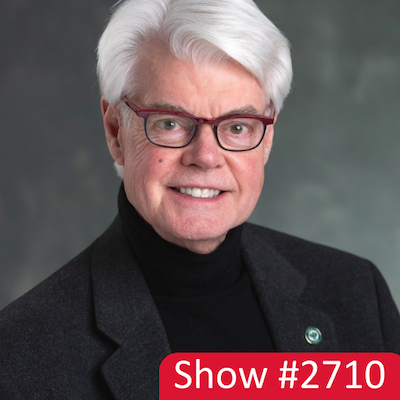
22 Dec December 23, 2025 – Former Skidmore Pres. Dr. Philip A. Glotzbach and Go Giver Bob Burg
Transcript
0:04 – Intro 1
Broadcasting from AM and FM stations around the country. Welcome to the Small Business Administration award-winning School for Startups Radio, where we talk all things small business and entrepreneurship. Now here is your host, the guy who believes anyone can be a successful entrepreneur, because entrepreneurship is not about creativity, risk, or passion: Jim Beach.
0:26 – Jim Beach
Hello, everyone. Welcome to another exciting edition of School for Startups Radio. Merry Christmas. Happy holidays. I hope you are having a great day, because we have a great show for you today. And not only do we have a great show, I want to point out that we have great Minutes this week. Let me explain what I mean. We produce a segment called the School for Startups Minutes, which are 90 seconds long. Figure that one out, right? There’s a history and a conundrum. These 90-second-long vignettes talk about a feature every week that’s got a theme. You know, the ten ways to retire happy, that kind of silliness, always with a number, except we do five. And this week we are doing the five ways Santa is the ultimate entrepreneur role model, and it is great. They make sense. It’s got some really good information in there. And Santa’s principles are fantastic. I don’t know if Santa knew that he had entrepreneurial principles, but he does. And they are in the Minutes. Go to the School for Startups Radio website and you will find the Minutes. We do them every week. They are a great add-on. I don’t talk about them enough here on the long-format show, but do go check those out this week. They are particularly good. Also, you know, what do I give you for a holiday present? Well, first of all, the show is free. It is my goal to create a mosaic where you can dive in and learn what you need, when you need it, from the type of resources that you need. So to that end, we have spent a lot of time continually updating the index on SchoolForStartupsRadio.com, so that there is a really good resource. And if you want to go in and look at all of our DEI lectures, you can do it that way. Plus, we have a pretty good search. And so I hope that you can find the pieces of the mosaic that interest you. You’re not going to want to listen to every interview. You’re not going to want to listen to marketing if you’re a finance person, right? But our goal is to provide all of the resources that you would need to get you ready to go start an incredible business, and to give you the motivation to do it. So the skills, the techniques, the tricks, the tips, and the skills, all of that is our Christmas present to you. Plus, we’ve also started doing, with regularity, really good transcripts of every show, and the questions are in there broken out so that you can see just one topic, and the timestamp is in there, so you can jump ahead and find exactly what you need. So we’ve invested in making that happen with regularity. And so again, Merry Christmas. Happy Hanukkah. Happy Kwanzaa. Happy Festivus to all of you. For whatever you celebrate, I’ve tried to give you a gift. Oh, the show today, we have, from Skidmore, Philip Glotzbach, talking about whether you should go to college or not, and how to finance, and all sorts of great stuff. And in our greatest hits, we have Go-Giver Bob Berg, one of the best-selling authors of all time. Forgot about that free stuff.
3:52 – Real Environmentalists Ad
Tired of talk and no action on climate change? Introducing The Real Environmentalists, the bold new book by Jim Beach. It’s not about activists, politicians, or professors. It’s about the entrepreneurs, real risk-takers, building cleaner, smarter solutions, not for applause, but for profit. The entrepreneurs in the book aren’t giving speeches. They’re in labs, factories, and offices, cleaning the past and building clean products for the future. The Real Environmentalists is available now, because the people saving the planet aren’t the ones you think. Go to Amazon and search for The Real Environmentalists. Thank you.
4:24 – Jim Beach
We are back, and again, thank you so very much for being with us. I’m excited to welcome a fantastic guest to the show. This is a little bit different from what we normally talk about, but his new book is right up the alley, and I think it’s some topics that we need to talk about, as you do your financial planning and figure out how you’re going to get your kids educated and all that stuff. Please welcome Dr. Philip Glotzbach to the show. He was president of Skidmore College for 17 years. During that time, he had tremendous success growing the campus and helping to diversify the student body and bring in more financial aid. Prior to Skidmore, he was a dean at the University of Redlands, and prior to that, he taught at Denison. Very impressive. Dr. Glotzbach, welcome to the show. How are you doing?
5:17 – Dr. Philip A. Glotzbach
I’m doing great, Jim. Thank you. Thanks for inviting me to your broadcast.5:21 – Jim Beach
It is our pleasure. Today we’re going to talk about his new book called Embrace Your Freedom: Winning Strategies to Succeed in College and in Life. Congratulations. It is five-star rated on that Amazon place. Is college right for everybody? Are we sending too many kids to college
5:42 – Dr. Philip A. Glotzbach
It’s certainly not right for everybody. There are a lot of different pathways that people can pursue. Goodness gracious, we need great mechanics and plumbers and carpenters and all kinds of other things. Students coming out of high school can go into the military. They can do a lot of different things. So I think college should really be a choice. That’s one of the first things I say in my book to students. It shouldn’t just be the next thing that people expect you to do after you graduate from high school. It’s a terrific opportunity. It’s a wonderful way to grow up, intellectually and personally. And there are all kinds of great reasons for going, but students should really ask the question of why they want to do it, and think about that, and talk with their parents and their guidance counselors, and then go. If they’re going to go to college, be intentional and on purpose about it.
6:31 – Jim Beach
That was my big problem. I was intentional about nothing during college. And get this, Philip, I actually had enough credits to graduate, and I stayed a year longer at Middlebury’s tuition rates, a year longer, just so I could be there. I didn’t want to leave yet.
6:49 – Dr. Philip A. Glotzbach
I get it, and your parents were nice to support you in that.
6:53 – Jim Beach
They didn’t. They didn’t know.6:57 – Dr. Philip A. Glotzbach
It was on a need-to-know basis, right? Yeah, I get that. Well, you know, a college is a wonderful place to be for all kinds of reasons. And it’s asking a lot of an 18-year-old to say, “Gee, you should be on purpose here. You should be thinking about things.” I don’t expect students to have all the answers to the questions that are around this idea, and in my book I’ve really challenged them to begin this process. Let’s begin thinking about what you want to do, why you want to do it. Those ideas can change over four years, goodness knows. But I do think that you’re better off if you think about the why for yourself, your personal why, and that can give you some motivation to take advantage of all these opportunities that your college or university
7:47 – Jim Beach
Is college too plush, too cushy, too easy at this point? Too many A’s, too nice of facilities. You don’t have to live in that nice of a dorm. College students are supposed to rough it a little bit. It’s not supposed to be as nice as life.
8:05 – Dr. Philip A. Glotzbach
Yeah, that’s right. We used to say that the students at Skidmore are going to probably live in, they’re not going to have this quality of living experience for a few years after they graduate. So, you know, is it necessary? I don’t know. Colleges are competing for a decreasing pool of students these days. They do try to provide amenities for students, but I think that the main point about a college or university is what they provide in the classroom and what they provide in their out-of-classroom experiences. So those are the things that really count. The campus environment is nice, can be great, but I think that’s not the most important thing. Is college too cushy? I don’t think most students today would say it’s easy. The students that I encountered were really very busy. Oftentimes they had a major and a minor, maybe two minors, maybe double majors. They had outside activities. They were in clubs. They were in organizations. They were playing athletics. They were very busy, and they worked their butts off. So I don’t think any of them would have said it was cushy. The whole question that you raised about grades, grade inflation, that’s an ongoing conversation for colleges and universities. But I don’t know that a lot of students would say they think it’s easy
9:28 – Jim Beach
Okay, I think it’s easier. You know, not necessarily the academics, just the whole lifestyle, the cloistered lifestyle, I think it’s a lot easier than being 25, paying power bills.
9:39 – Dr. Philip A. Glotzbach
I think you’re right. I think you’re right. Once you get out, you realize, “Oh my goodness, now I really am responsible for all these things,” some of which were provided by my college, like a place to live and a place to eat and all that. I think the justification for that, excuse me, is the fact that these four years represent a very unique opportunity. They come once in a lifetime. And as I said, there’s an awful lot that college students are expected to do and that they expect themselves to do. And so the amenities that a college or university provides really ought to be focused on giving the students the environment they need, really to focus on their highest priorities, and to focus on their academic work and to focus on the things that will get them ready for that next stage in their life. They don’t have to worry about, you know, where am I going to live and where am I going to get my next meal? Now, let me just say, not every college student has that experience, and for a lot of students, college is stressful and difficult in all kinds of ways. You know, 20% plus or minus of college students across this country have kids. They’re parents. That is really challenging to do. Other students may be in a college or university where they’re really stretched to pay for it, to afford it. Their family can help them only a certain amount. They may have one or two jobs. I mean, all these things add to stress and to the difficulty of a college environment. So I don’t want to minimize any of that, but I think schools should be doing everything they can to help students in those situations, whatever, deal with their life issues and their challenges, so again they can focus on the opportunities that the school is providing and take the most advantage of them. That’s really what it’s all about.
11:36 – Jim Beach
Has it gotten too expensive? In the ’50s, I imagine the student could go to work and pay for Skidmore and make it on their own, more or less. I don’t think that’s possible today. They’ll end up $100,000 in debt.
11:55 – Jim Beach
Is that fair? Are colleges too expensive because we have too many climbing walls?
12:01 – Dr. Philip A. Glotzbach
They are expensive, and I don’t know that the climbing walls are part of the problem. You know, a recent study that I just read tracked the net college costs over the past decade. And in fact, those are the costs net of financial aid for students. And those costs actually decreased over that period of time for every kind of college or university, for public universities, for private colleges, and so on. The sticker prices are pretty amazing. And you look at those prices and say, “Geez, $100,000 a year. How do I pay for that?” But the reality is that colleges and universities provide enormous financial aid, and students who are fortunate enough to have the family resources where their parents can write that check, that’s great, and they can do that. But the vast majority of students are going to be offered financial aid. They may have a campus job and so on, and it can be affordable. Students, I say this in my book, students really ought to manage their college affairs to try to have no more debt, you know, to take out loans no more than they can pay off in a couple of years. It really shouldn’t be any more than you can imagine yourself earning as a gross amount in your first year out. Now, you’re not going to pay off your loans your first year out. We all know of the horror stories. There are students who go through undergraduate careers and come out with more debt than should be reasonable, and they struggle getting a job. And those stories are real enough, that’s true. The average student debt across the country is in the low 30,000s, and that’s reasonable. I mean, that’s a used car, for goodness sake. So students should be able to manage that, working with their parents. The worst thing that happens, and I’m sorry to go on a little bit here, is when a student goes to a school and qualifies for financial aid, and then the school gaps the student, as we say in the business. That means the school says, “All right, you’ve filled out the federal financial aid form, and here’s the amount of financial aid you should be eligible for. We cannot give you that full amount. There’s going to be a gap between what your financial aid form says you should be able to receive and what we can give you.” And so students try to fill that in with loans. That’s when things start adding up. So students should be really wary of that. Colleges should not gap students. Unfortunately, many of them seem to believe they have to, because they don’t have the financial resources. Anyway, I would hope that I would encourage students, and I do in my book, encourage students really to be very aware of how much financial aid they’re going to be getting, what the demands upon them are going to be, and their family financially, what’s that going to be for four years? And by the way, one of the worst things a student can do is to stretch out those college years if you’re taking on debt and so on for an extra year, because then you’ve got another year of debt, another year of expenses, and another year when you’re not out there in the workforce earning a paycheck. So the best thing you can do is to focus on your work to graduate in four years, or even fewer years if you can. Like you, you accumulated enough credits to graduate. You didn’t have to stay. That also helps minimize debt. So it’s possible for students to go to a great four-year institution and come out without excessive debt. It happens all the time. And the sticker prices are unfortunate, but if you compare what’s happened in the economy over the past 20 years, educational costs really have not risen faster than the costs of inflation. And in fact, the net cost of a college or university education since, let’s say, 2016 has actually decreased, while the cost of living has increased over 20%. So those are financial realities. We don’t see those in the headlines all the time.
16:09 – Jim Beach
What about the softest of the liberal arts degrees, sir? I majored in African dance, and I have $90,000 in student debt. We’re never going to get that person out of that hole. You know, they’re not going to have a career in African dance that’s going to pay off $90,000 in debt, right? Should we allow that to happen?
16:35 – Dr. Philip A. Glotzbach
Well, I think students have to take responsibility for their choices in these matters also. But let’s put it this way. First of all, only about a third of students actually end up doing something that’s directly related to their major. And I could, you know, we could talk about what your major was. Mine, I was a philosophy major. I ended up teaching philosophy, so I’m one of those one-third. But I did not major in becoming a college president. I had to learn to adapt to different opportunities that came along the way, and that’s something that’s characteristic of the professional world today. It’s a world that’s changing. It’s changing before our eyes. It’s changing at an amazing rate. So what students really need to do is to develop a set of cognitive skills, a cognitive Swiss Army knife. They need to be able to read critically, to think critically. They need to be able to write, to communicate. They need to be able to access knowledge from a range of different disciplines. They need to be flexible enough to change their mind about things. They need to be able to adapt to new situations. They need to be able to continue learning. Those are the characteristics that you need to succeed in the workplace today, and you can learn those skills over a range of majors. Really, in principle, you ought to be able to learn them no matter what you’re taking in college, because you ought to be doing enough general education courses to help develop those skills. And your major should be encouraging you to develop those skills even further, regardless of the subject matter. So choosing a major actually matters less than one might think. And there are some other things we can talk about, getting into the work world, but the main thing is to come out with a set of cognitive abilities that will enable you to succeed in a workforce that’s just changing at an enormous rate.
18:24 – Jim Beach
Yes, it is. It’s going to be fascinating to see AI and all the other things end up doing to our job market.
18:34 – Dr. Philip A. Glotzbach
That’s right. Well, I just looked at it, saw an article recently that listed 40 jobs that the author claimed would be going away because of AI. And, you know, there was a pretty interesting range of jobs. I’ll read some of them: journalists, translators, librarians, tutors, construction laborers, HR recruiters, delivery couriers, personal assistants. And there were, you know, 30 others. Now, is that exactly going to happen for everybody? No. But the point is that a lot of things that people thought might be a, you know, guaranteed career path. For example, artificial intelligence is going to put a lot of computer programmers out of work. And in fact, some of the high-tech firms are in the business of laying off computer science majors right now. And so my point is that you really need to be able to adapt to, you know, changes and opportunities that are out there. What are the skills that are required to manage this environment where jobs are going away because of artificial intelligence? Well, they’re the things that artificial intelligence still can’t do: skills involving human empathy, storytelling, the capacity to think in creative ways. Those are the kind of things that are going to make somebody marketable and successful in the workforce. And by the way, artificial intelligence is raising its own set of questions, and we know about this. You know, how do you regulate this thing? What are the threats that artificial intelligence might present to us? Those are philosophical questions. Those are questions in political theory, political science. The world is going to need people who can think deeply about those kinds of issues and help us to see if we can get a hold of this artificial intelligence piece before it turns around and devours us.
20:32 – Jim Beach
So, as a philosophy major, does AI, this is from the movie, does AI dream when it’s unplugged? In other words, that was the question. How does HAL 9000 know that it is what it is? Has it gotten consciousness yet? No.
20:59 – Dr. Philip A. Glotzbach
And I think anybody who understands how AI works today, and the fact that it’s based on enormously powerful computing resources to enable it to pull in data from an unimaginable array of sources, would say the same thing: it’s not conscious. It can interact with us in ways that can make us think it’s conscious, and we human beings have a propensity to project onto AI systems, as they become increasingly sophisticated, a kind of sensibility. Or, you know, it could be easy for us to kind of make the mistake of thinking that it actually is conscious. There’s a whole history to this discussion that I won’t go into, but it is certainly powerful. It certainly can do things, and what we need to do today is to understand how to use it. Students need to understand what’s going on with AI, because they’ll be expected to use those resources in their professional world. So many jobs are going to be requiring people to work with AI as a tool. I would just say one thing: for college students, the key thing is, number one, to understand how AI works. And if you want to major in it, so much the better. We need people to continue to do that work. Or again, if you want to do coursework that helps us think about how to regulate this ongoing development of AI, so much the better. But the main thing I would say is, the temptation is going to be increasingly for students to outsource their own thinking, because you can use AI, you know, ChatGPT and the like, to do a lot of the work that in the old days, when you and I went to school, we had to do on our own, you know, to read, to summarize, to write first drafts, and so on. I’m not saying that you shouldn’t use those tools to help you and ultimately produce a better work product. That’s great. But don’t fall into the trap of turning over your thinking to some AI program without maintaining control over whatever it is you’re writing or what you’re learning, because if you do that, number one, trusting an AI program too far can lead you down all kinds of rabbit holes. There are just too many ways in which AI programs make mistakes. But number two, you’re shortchanging yourself, because we still need to do all the things that I mentioned before, and I won’t repeat them. But you learn those skills by doing the hard work of reading, writing, thinking, studying, and don’t outsource that. Don’t succumb to the temptation of outsourcing all that stuff to your favorite AI program.
23:54 – Jim Beach
Yeah, it’s going to be fascinating to see how it plays out. Job market, academically, everywhere. I think a lot of these jobs that they say are going to disappear, I think that’s ridiculous. I don’t think that’s going to happen. People still have to tell the AI what to program, right? That’s still a programmer, you know? So absolutely, I think there may be fewer jobs, but I don’t think the jobs go away. They just evolve. Seems to me that every one of the super big predictions, my favorite was, you know, the whole idea of the printer, how using a computer instead of a typewriter would save so much paper because you don’t have to print or reprint when there’s an error. And I’m like a lot of people: I make five changes, I reprint. I make three more changes, I reprint, you know, and so—
24:51 – Dr. Philip A. Glotzbach
Well, statistically, you’re dead on, because studies have shown that paper usage increased exponentially when computers came in. So you’re absolutely right. It doesn’t save paper in the long run. And you know, there’s a reason for that. Paper is a very efficient technology. Putting something on a piece of paper can help you preserve it forever, as opposed to having something in the computer system that might change five years out and you can’t access it again. It also is a different experience, and studies have shown this: reading something on paper is a different experience from reading it on a screen. And there are all kinds of reasons to have a paper copy in front of you when you’re working on, you know, editing a piece that you’ve written, editing a book you’ve written. So yes, it hasn’t saved paper.
25:44 – Jim Beach
In your book, I want to go through some of the points you make. We only have a couple of minutes left. What is Embrace Your Freedom, your new freedom, actually, the actual title. Are you talking about freedom? My mommy and daddy aren’t here to watch what I’m doing.
26:01 – Dr. Philip A. Glotzbach
Yeah, thanks for asking that. I think it’s a great question about the book. I identify two forms of freedom, two aspects of freedom, both of which are important. The negative aspect of freedom is exactly what you’re talking about. It’s the absence of external control. So yeah, my parents aren’t here anymore, so nobody’s going to tell me when to get up in the morning or when to go to bed at night, and so on. That’s a very important part of freedom, and people have fought revolutions and wars over that kind of freedom. But in terms of being a college student, there’s a more interesting form of freedom, a positive form of freedom, which really is the capacity to accomplish goals that you set for yourself, and that requires discipline. It requires planning. It requires self-direction. And that form of freedom, making yourself capable of accomplishing something that you weren’t able to accomplish before, but it’s an important goal for you, that’s the part of freedom that I’m really challenging students to embrace. And that requires taking on your life as a kind of project. So embracing that freedom means figuring out what you need to do to accomplish those goals, what you need to do to position yourself as you go through your college career to accomplish what you want to do with the next stage of your life, and so on. So that’s the kind of freedom that I’m asking students to embrace. It’s much more complicated and much more demanding than just the negative sense of, “Gee, nobody’s telling me what to do.” Does that make sense?
27:33 – Jim Beach
Yes, it does. Make no small plans.
27:3 Dr. Philip A. Glotzbach
You know, this is a time in your life as a student when you really ought to be thinking, “What could I do if I knew I absolutely couldn’t fail?” It’s a great time to dream big, as people say. And you know, over time, as we get a little bit older, maybe our horizons tend to narrow a little bit. But it was Michelangelo, I think, who said that the tragedy is not people who aim too high and fail, but people who aim too low and succeed. This is a time, really, in this part of this notion of being intentional and being on purpose and going to college, to ask, “What would I do if I knew I didn’t have any constraints? What can I accomplish? What do I want to accomplish?” So that’s the “make no small plans.” And I think that that’s the place where college students should start. They should think about where it is that they want to be with their life. And again, you don’t have to have all the answers right away. Nobody can do that, but you can start thinking about it. And don’t limit yourself by what other people have told you you can’t do, for example. Or you may never have imagined that you could do whatever it is, become a songwriter, let’s say, or whatever. People do this. Human beings do these things. As a student, I would say to you, look, you’re a human being. What do you want to do? Other people have done these things. You could do them too, if you’re willing to put in the time and the effort and the work. Now, not everybody can do everything. You have to have some ability as well. That’s true. So the other part of this is to find out what you’re good at, and that’s part of even choosing a major. What are you good at in the academy? What gives you satisfaction? Where do you have some success? Take that information and build on it to see, again, what you want to do as your next steps. So it’s a combination of what you can do well, but also what you want to do.
29:32 – Jim Beach
The book is Embrace Your Freedom: Winning Strategies to Succeed in College and in Life. The author, Dr. Philip Glotzbach. Sir, thank you so much for being with us, and congratulations on retirement. Enjoy. Have fun.
29:48 – Dr. Philip A. Glotzbach
I’m trying to, and you know, writing is fun too, so I’m enjoying that very much. And speaking of which, has your book appeared yet? I’m curious.
29:55 – Jim Beach
It has. It is not selling as well as yours right now, but we’re still pushing it and trying to get it out there. Yeah. So thanks for asking.
30:07 – Dr. Philip A. Glotzbach
Well, good luck with that. Promotion is much harder than publishing. So much harder. Yeah. Well, Jim, thank you so much for inviting me on and for chatting about the book. I hope that what I’ve said makes some sense to your listeners.
30:22 – Jim Beach
Appreciate it likewise, and we will be right back.
30:41 – Intro 2
Well, that’s a wonderful question, actually. Oh my gosh, I love the opportunity to do this. Thank you, Jim. Wow, that’s a great one. You know, that is a phenomenal question. That’s a great question. And I don’t have a great answer. That’s a great question. Oh, that is such a loaded question. And that’s actually a really good question. School for Startups Radio!
31:05 – Jim Beach
And welcome back to School for Startups Radio. Again, thank you so much for being with us today. I am incredibly honored and excited to welcome back to the show the very famous Bob Burg. He is one of those people that just doesn’t need an introduction. He is one of the best-selling business training, sales training authors of the last three decades. His book The Go-Giver went to number six on the Wall Street Journal’s bestseller list. Just after three weeks of publication, it reached number nine on BusinessWeek, and since then, it has been in the top 25 continuously. Ever since then, it’s been translated into 21 languages and has sold over 500,000 copies, making it one of the best-selling business books of all time. And just recently it came out in a new edition, a new, expanded edition. And you may remember that his co-author, John David Mann, was on the show a couple of weeks ago. Mr. Burg, welcome back to the show. How are you doing today? It is our honor.
32:12 – Bob Burg
Hey, Jim, the honor is mine. Always a pleasure to be with you, and thank you for those very kind words.
32:17 – Jim Beach
Well, it’s an amazing career, absolutely amazing. I’d like to start right there. How did you get started? How early in your life did you realize that you were going to be a little bit more successful than your peers, a little bit more successful than the other kids you went to school with? What set you apart at the absolute earliest?
32:39 – Bob Burg
Well, actually, I don’t know how much more successful I am than people I grew up with, because there are actually a few people who did great. They probably have way, way bypassed me in certain areas. I think with me, it was always more a concern if I was going to be more successful than I was at present. And I never knew, or at times I never knew, if that was going to happen or not. Because I think, like anyone else, there were a lot of failures along the way and a lot of discouragement, and you kind of find a way to work through them, and hopefully things come out. But the speaking really happened by accident, in a way. Well, not accident, but through a series of situations that occurred. I began in broadcasting and moved very quickly over into sales, where once I learned a system for being able to sell effectively, I kind of progressed in that regard, became sales manager of a company, and then attended a seminar where I ended up selling that person’s, back then, you know, 35 years ago, 30 years ago, whatever, so we’re talking about tapes, not CDs or anything. And they taught me how to speak at different groups, clubs, organizations. I’d speak for free, and then I’d sell their tapes, their tape program, at the end. And I kind of had a knack for that, again, once I learned a system for doing so. And then, little by little, I began breaking out on my own, teaching my own information and topics. And that’s sort of what morphed into speaking. So then it was a matter of learning how to set up and run a successful speaking business. So one of the themes that runs throughout that, perhaps, is that at a certain point, I realized that I really wasn’t smart enough to invent my own systems, but I could learn systems that were out there and apply those successfully in my own life. And I think that was really a key for me when I realized not only did I not have to reinvent the wheel, trying to do so was only going to hold me back.
34:50 – Jim Beach
But that has changed. At some point you were able to come up with your own incredible content. The Go-Giver wasn’t something that you copied, borrowed, or stole from somebody else.
35:00 – Bob Burg
That’s right. No, it wasn’t. It wasn’t content I couldn’t come up with. No, I’ve been able to do that. It was systems for running a business. In other words, systems for selling, systems for marketing, systems for once I decided to become a professional speaker. Okay, how do you go about marketing and selling yourself as a speaker? So no, the content, that first content when I was selling for someone else, which is something many people do, you know, I had the rights to sell that person’s content, and they taught me how, and that was fine. That was a win-win for all of us. But no, eventually I began my own intellectual properties, if you will. And that was when I began talking about networking and relationship building and winning without intimidation, which was really just people skills. And then eventually The Go-Giver, which John David Mann and I teamed up on. So no, I’ve been creating content, creating and co-creating content, for 20 years, 25 years. But learning business systems is what I understood I needed to be able to do.
36:04 – Jim Beach
How important is an incredible memory to being a great salesperson? Your first book was called The Memory System, about how to have a better memory and remember people’s names, and the very important Bill Clintonian ability to remember people 20 years later, and what you ate when you were sitting there talking to them, and what their wife’s name was. How important is that to your incredible ability to be a salesman?
36:33 – Bob Burg
It’s very, very important. And the reason I began teaching it is because first I began learning it, because I had a terrible memory. And really, it’s not that terrible a memory, but an untrained memory, and the results are the same. Whether it’s untrained or just terrible, the results are the same. So I had actually taken a memory course because, as a salesperson, that was something that really held me back. And once I learned, and again there was a system for it, and you know, you hear me talk about systems a lot. And I personally define a system as the process of predictably achieving a goal based on a logical and specific set of how-to principles. In other words, if it’s been proven that by doing A you’ll get the desired result of B, then you know that all you need to do is A and continue to do A, and you’ll eventually get the results of B, again, if it’s been proven. So I learned a memory system, and it made a dramatic difference for me. I mean, in terms of self-confidence, in terms of effectiveness, in terms of how liked and respected I was, because I could remember others. Because remember, when it comes down to it, it’s always about the other person. It’s never about us. And so as I started to get good at that, and those were the person’s tapes that I started to sell, and then I began to develop my own programming. But yeah, I found that was a big boon for me. It’s something that’s helped me through the years, and it’s something I’ve really become known for, that people are surprised in an audience when we meet before the program, or sometime, where I’m able to call out people by name and so forth. So yeah, it’s huge.
38:12 – Jim Beach
And another thing that I’m hearing is a lifelong pursuit of continual learning. You graduated from school, but yet you still went out there and took classes on sales and developing systems and how to perfect your own memory. How important has it been to your career, to what you do, to be the guy that’s always still continuing to make yourself a better person?
38:38 – Bob Burg
Yeah, well, my learning really began after formal schooling, because I was a horrible student. I always say that I, well, and this is true, but I was accepted into college, it was a very small college, I was accepted into college on academic probation. And I kind of joke and say, well, that part was true. Then I kind of joke and say, well, I also graduated on academic probation. And the only reason that’s not true is I don’t think, I think once you graduate, you just graduate. But it was by the skin of my teeth, both high school and college. But what’s interesting is, once I got into sales, that’s when I started to realize, that’s when I discovered the world of personal development. Because really, when you think about it, sales is about understanding people. It’s about understanding others. It’s about understanding ourselves. And I was introduced to this amazing new world that I just totally embraced. I think the first book I read was Think and Grow Rich by Napoleon Hill, and then How to Win Friends and Influence People by Dale Carnegie, and The Magic of Thinking Big by Dr. David Schwartz, and Psycho-Cybernetics by Maxwell Maltz. All of a sudden, I’m just loving this continual learning, and I can feel myself growing on the inside, which is really what needs to happen before it manifests on the outside.
39:58 – Jim Beach
To become a great salesperson. Let’s go back, I guess, to some of your early books where you focused on sales and building leads. Your second book was Endless Referrals. How can my entrepreneur listeners today work on their sales techniques? Give us some steps that we should do to get out there and become better salespeople. So many entrepreneurs are great coders, great programmers, very original thinkers, but they have no idea how important sales is going to be to their career. Talk to them, right?
40:33 – Bob Burg
And Michael Gerber, in his E-Myth series, calls people like that technicians. In other words, they are just absolutely great at their core competency. They are fantastic. And yet they have sort of a resistance, if you will, to the selling and marketing processes, though that shouldn’t be a part of the business, you know. Well, it is. It is a part of the business. So you do need to know how to sell yourself, and you need to know how to sell your products and services. So it’s something to definitely work on. There are great books out there on the topic. And whether you start with people that I started with, Zig Ziglar, his books, and Tom Hopkins, you know, timeless wisdom in terms of sales. And today there are people like Jill Konrath and Jeff Gitomer. And I’ll tell you a great one. He’s coming out with a new book soon, his first book, and I’m so glad, because to me, he is the go-to person right now when it comes to sales. His name is Anthony Iannarino, spelled I-A-N-N-A-R-I-N-O, and he has a blog called The Sales Blog. And it is absolutely, it’s, to me, it’s a not-miss. And so I think there’s people that, so my suggestion would be, look up those people who have mastered the craft, who’ve mastered the art, and who have written about it and who are teaching about it, and learn from them. Now, here’s the interesting thing, and I always say this when it comes to authenticity: learn from everyone. Learn from these people. Adapt their wisdom, but don’t adopt their personalities. You know, stay yourself. So in other words, learn their wisdom, absolutely, but don’t try to be them. Don’t try to sell like them. Don’t use their personalities. Stay yourself, but just understand there is a skill set involved, and it’s very important to understand that.
42:30 – Jim Beach
Let’s talk about The Go-Giver. Congratulations on the new version and the incredible success that that book has had. Talk to us. Tell us briefly what the fable is about, and how you came up with this idea, how, over any number of years, the concept of giving first came to you, and how you learned how important and valuable that could be.
42:56 – Bob Burg
And it’s a business parable, a story about a guy named Joe, who’s a young, up-and-coming, aggressive entrepreneur, salesperson, actually, with really great potential, but his focus is in the wrong place. It’s kind of all about him. It’s about who owes what to him, and it’s about what he needs to do. And what happens is he meets a mentor by the name of Pindar, and some other people who Pindar introduces him to over the course of a week, and he comes to learn a very, very valuable lesson. And that is that shifting your focus, and this is the key, shifting your focus from getting to giving. And when we say giving in this context, we simply mean constantly and consistently providing value to others. And doing so is not only a nice way to live life, but a very financially profitable way as well. Why? Because no one’s going to buy from you because you want them to, or because you need the money, or because you have a quota, or because you have the best product or service out there. They’re only going to buy from you, they’re only going to do business with you, because they believe that doing so is more beneficial to them than not doing so. And what that tells us, in a very logical, rational way, is that your focus must be on pleasing them, on communicating value to them in a way that they see as being of value. That’s the key. And this is why we say that money is an echo of value. It’s the thunder to value’s lightning, which means the value must come first, and the money you receive is simply a very natural and direct result of the value you provide.
44:40 – Jim Beach
And was it autobiographical in some sense? You know, was this something that you learned through time? Did you have certain experiences that made you realize this?
44:51 – Bob Burg
Well, you know, when I was first starting out in sales, when I was first starting to get my legs out from under me, and I was starting to do well, but it was still off and on, I think my focus was in the wrong place. And it was a gentleman who I met only one time. He was a retiring guy, and I think he saw me as an up-and-comer who really needed to have a shift in focus. And he took me aside one time and he said, “Berg, if you want to make a lot of money in business, if you want to make a lot of money in sales, don’t have making money as your target. Your target is serving others, or serving your customers.” He said, “Now, when you hit the target, you’ll get a reward. The reward will be money, and you can do with that money whatever you’d like, but never forget, the money itself is only the reward for hitting the target. It’s not the target itself. Your target is serving others.” Well, that has a lot to do with our first law, the Law of Value, which says your true worth is determined by how much more you give in value than you take in payment, which means nothing more than that the experience you provide for that person, based on focusing on their needs, their wants, their desires, has got to be so exceptional that they’re happy to trade their money for that value. And when you do that, they profit, and you profit. And so, you know, it’s things like that that were part of my life. And of course, John was a very successful entrepreneur, so when we came together on this project, the five laws were built around those things that he and I had both studied, had both learned, and both had applied in our own individual businesses.
46:29 – Jim Beach
All right, so law number one is the Law of Value. Can you walk us through the remaining four laws?
46:36 – Bob Burg
The Law of Compensation says your income is determined by how many people you serve and how well you serve them. So it’s not just a matter of providing great value to one person. You’ve also got to impact the lives of many others. Hence the importance of a referral-based business and developing what one of the mentors in my story told Joe is an army of personal walking ambassadors. They help you expand your reach. Law number three is the Law of Influence, which says your influence is determined by how abundantly you place other people’s interests first. Now, when we say place other people’s interests first, this doesn’t mean you should be a doormat or a martyr or self-sacrificial in any way. Absolutely not at all. But as Joe learned in the story, the golden rule of business is that all things being equal, people will do business with and refer business to those people they know, like, and trust. And there’s no faster, more powerful, or more effective way to elicit those feelings toward you and others than by, as Sam, one of the mentors, told Joe, stepping outside yourself, moving from an “I” focus to an “other” focus, making your win about the other person’s win. And then you’ve got the Law of Authenticity, which was shared by Debra Davenport, one of the mentors, and that simply says the most valuable gift you have to offer is yourself. That means that you show up as yourself day after day, week after week, month after month. People know who they’re working with. They know who they’re talking to. And you begin to develop a reputation among people as someone of high integrity and high character. And people know who you are and what you stand for. And then there’s law number five, the Law of Receptivity, which says the key to effective giving is to stay open to receiving. This means that while it’s important to breathe out, we also must breathe in. Giving and receiving work together. They’re simply two sides of the very same coin. And while we need to focus on the giving of value, we also need to allow the receiving.
48:43 – Jim Beach
When John was on the show a couple of weeks ago, we had an interesting conversation about how this philosophy has changed the business at the Chamber of Commerce coffee-meeting level. When you walk into a Chamber of Commerce today, there’s the guy who sells trinkets for a living. He sells frisbees and pens, corporate ID, corporate junk, right? You know, the paperweight that you give away to your customer, the calendar that the insurance man gives you at the beginning of the year. And that man has heard your message and comes up to you and says, “How can I help you today?” And you know that he’s trying to sell you a pen with your logo on it, and that there’s probably no way he can help you, but you also understand that he’s trying really hard. How should you respond to that person? You know that there’s really nothing that they can do. They’re selling you pens. You don’t need any pens right now, but they’re trying so hard to give back. How do you respond?
49:46 – Bob Burg
Well, you know, I would more carry on the conversation with him or her in a way that shows my genuine interest in them. I might tell them, “I appreciate your offer. It’s not something I need at this time.” But then I’d ask them about themselves. “How did you get started in this business? This looks very interesting.” And now they’re a little taken by surprise, because people don’t usually ask them that, and they realize that they feel pretty good about being asked how they got started in their business. And then you might ask them, “What do you enjoy most about what you do? You must have had some great experiences, helped a lot of people.” And again, they feel great about that. And wow, this person’s asking some great questions, and so forth. And then you ask what I call the one key question, which is, “How can I know if someone I’m speaking with would be a good prospect for you?” And they’re really taken aback. But what you’re doing is you’re teaching this person. You’re teaching this person that to the degree you can take your focus off yourself and not just try to hit someone up for business, but instead begin to cultivate a relationship, that’s the degree people are going to be attracted to you. That’s the degree people are going to want to get to know you better. So yeah, a lot of the chambers now are using the book and suggesting it to people, because again, it’s about a shift in focus. It’s realizing that when you take your focus off yourself, you’re much more likely to have other people interested in you. Why? Because when you’re genuinely interested in others, and here’s something key, the single greatest people skill, because we know how important people skills are, the single greatest people skill is a highly developed and authentic interest in the other person. And when that’s the case, people will bend over backwards and go out of their way to be a part of your life when they can tell that you genuinely are interested in them.
51:39 – Jim Beach
I think that the Best takeaway I heard right there, Bob, was the ultimate question, as you called it: “How do I know if I’m speaking to someone that would be a good referral for you?” You know, that is, I think that’s the best thing that you could give to a pen salesman, is teach me how to find great clients for you. That’s a very hard question for them to answer, though, isn’t it?
52:05 – Bob Burg
Well, it depends. It shouldn’t be, but it often is because they haven’t really thought about it. What they’ll do is start telling you about the product or service itself, which isn’t the important part, but rather how to identify someone. For example, if you were talking to a person who sells copying machines and you ask them, “How can I know someone I’m speaking with would be a good prospect for you, or a good referral for you?” If they start telling you about why the copying machine works so well, that does nothing in terms of helping you help that person. But if they say, “Well, if you’re ever in an office and you notice a copying machine, and next to that copying machine is a wastepaper basket, and that wastepaper basket is filled to the rim and overflowing with crumpled-up pieces of paper,” that’s a really good sign that the copying machine has been breaking down a lot lately, and that would be an excellent prospect for me. So now they’ve helped us identify someone who might be a good prospect.
52:57 – Jim Beach
Great advice, Bob. How can we get a copy of the book, follow you on social media, connect with you, all of that kind of thing, please?
53:04 – Bob Burg
You know, really, Jim, everything is at Berg.com, B-U-R-G.com, and they can go there. They can subscribe to my Influence and Success Insights, get chapter one of The Go-Giver, and connect with me on the various social media. It’s all pretty much right there at Berg.com.
53:20 – Jim Beach
Fantastic, Bob. Thank you so much for being with us today. Thank you for this book. I think it really has changed business in America, and my listeners would be stupid not to spend some time over the holidays reading it. Thanks a lot, sir.
53:33 – Bob Burg
I appreciate you greatly.
53:35 – Jim Beach
We are out of time for today. Merry Christmas. Happy holidays. Have a great day. Talk to you again tomorrow. Oh yeah, we’ll be back soon. Bye. Now you.
Dr. Philip A. Glotzbach – President Emeritus of Skidmore College and Author of Embrace Your Freedom: Winning Strategies to Succeed in College and in Life
What students really need to do is to develop a set of cognitive skills, a cognitive swiss army knife. They need to be able to read critically, to think critically. They need to be able to write to communicate. They need to be flexible enough to change their mind about things. They need to be able to adapt to new situations. They need to be able to continue learning.
Dr. Philip A. Glotzbach
Dr. Philip A. Glotzbach is a distinguished leader in American higher education, having served as the president of Skidmore College for 17 years. During his tenure, he spearheaded transformative initiatives that elevated Skidmore’s academic offerings, fostered greater diversity within the student body, strengthened the college’s financial health and aid resources, and enhanced its infrastructure and physical campus. Under his leadership, Skidmore achieved significant recognition as a nationally respected liberal arts institution. Before his time at Skidmore, Dr. Glotzbach held pivotal roles at the University of Redlands, where he served as dean of the College of Arts and Sciences and later as VP for Academic Affairs. His teaching career began in the Department of Philosophy at Denison University, where he was a valued faculty member for 15 years. He has been widely regarded for his insights into higher education and consulting on issues ranging from institutional governance to the value of a liberal arts education. Dr. Glotzbach’s academic credentials are rooted in his commitment to philosophy and education. He earned his Bachelor of Arts in philosophy from the University of Notre Dame and went on to Yale University, where he earned his Master’s, M.Phil., and Ph.D. in philosophy. Dr. Glotzbach is also an accomplished author. His recent book, Embrace Your Freedom: Winning Strategies to Succeed in College and in Life, reflects his dedication to the exploration of philosophy and education. The book delves into the importance of intellectual freedom, critical thinking, and the role of higher education in cultivating meaningful lives and engaged citizens. Through this work, he inspires readers to appreciate the enduring value of the liberal arts and the responsibilities that come with intellectual freedom.
Bob Burg – Keynote Speaker, Co-Founder and Coauthor of The Go-Giver Influencer: A Little Story About a Most Persuasive Idea

The single greatest people skill is a highly developed
and authentic interest in the other person.

Bob Burg
Bob Burg shares how a subtle shift in focus is not only a more uplifting and fulfilling way of conducting business but the most financially profitable way, as well. For more than 30 years he has helped companies, sales leaders, and their teams to more effectively communicate their value, sell at higher prices with less resistance, and grow their businesses based on Endless Referrals. Bob has regularly addressed audiences ranging in size from 50 to 16,000 — sharing the platform with notables including today’s top thought leaders, broadcast personalities, Olympic athletes and political leaders including a former United States President. Although for years he was best known for his book Endless Referrals, it’s his business parable, The Go-Giver (coauthored with John David Mann) that captured the imagination of his readers. The Go-Giver, a Wall Street Journal, and BusinessWeek Bestseller, has sold well over a million copies. Since its release, it has consistently stayed in the Top 25 on Porchlight’s (formerly 800-CEO-READ) Business Book Bestsellers List. The book has been translated into 30 languages. It was rated #10 on Inc. Magazine’s list of the Most Motivational Books Ever Written, and was on HubSpot’s 20 Most Highly Rated Sales Books of All Time. Bob is the author of a number of books on sales, referrals, influence, persuasion, and people skills, with total book sales exceeding two million copies. Bob is an advocate, supporter and defender, of the Free Enterprise system, believing that the amount of money one makes is directly proportional to how many people they serve. He is also an unapologetic animal fanatic and serves as part of a South Florida rescue, foster, and adoption organization.