

17 Dec December 17, 2025 – Making God Laugh R.C. Goodwin and Disrupt You Jay Samit
Transcript
0:04 Intro 1
Broadcasting from AM and FM stations around the country. Welcome to the Small Business Administration award-winning School for Startups Radio, where we talk all things small business and entrepreneurship. Now, here is your host, the guy that believes anyone can be a successful entrepreneur, because entrepreneurship is not about creativity, risk, or passion: Jim Beach.
0:26 Jim Beach
Hello, America and the rest of the world. I hope you are having a great day. Welcome to School for Startups Radio. I’ve got a great show for you today: two fantastic guests and conversations. First up today, we have R.C. Goodwin. Rob is a psychiatrist and has a book out called Making God Laugh. I think that’s a hysterical title. We have a far-ranging conversation on a wide, broad set of topics, including AI and how it makes answers too easy. Great conversation. You will enjoy it. And then, in the greatest hits, we have Jay Samit, one of the most credentialed people I have ever met, and I’ve met some amazing people. Jay is with us, and as you know, that’s rebuilding our lost library of greatest hits. So that is what we are doing: getting it up on the server. Great show. We’re going to get started right now. We’re going to go off on a little bit of a tangent now and have a different type of conversation. I’m excited to welcome R.C. Goodwin to the show. He goes by Rob. He has had a very successful career as a medical doctor. He started off at Yale, then went to medical school in Dublin, came back for his internship in psychiatry, and did his residency in psychiatric care. Since then, he has devoted his practice to helping very needy people in jails and prisons and nursing homes and substance abuse facilities. He has written several books, including, most recently, Making God Laugh, but he has other books as well. We will be talking about those. He has won several awards. Kirkus named The Stephen Hawking Death Row Fan Club one of the Kirkus Award winners. What an interesting title. Rob. Welcome to the show. How are you doing? 2:22 R.C. Goodwin
I’m doing fine. Thank you, Jim.
2:24 Jim Beach
So tell us about your career and how it got on this particular path. What drew you to psychiatry?
2:31 R.C. Goodwin
Two things, really. I thought that it would hold my interest over time more than any other field or branch of medicine, any other specialty, and I thought, kind of intuitively, that I’d be fairly good at it. I would like to think that’s been the case. It certainly has held my interest over time for over a half a century now.2:59 Jim Beach
And what about, in particular, the field of the less fortunate? You could have taken care of rich millionaires who have, you know, rich people problems.
3:13 R.C. Goodwin
I think that would get old pretty soon. I prefer variety in my private practice. I’m a generalist. I had patients as young as 16, and I had ones that were over 90. I had priests, pimps, executives, people in jails and prisons. I had a couple of serial killers. Anyone could come to me with different kinds of problems or issues. If you had a teenager who was acting out, if you were suicidally depressed, if you were manic, I would never know on a given day, or a given week, or month, what I would be dealing with, and I rather like that.
4:02 Jim Beach
Is depression a chemical imbalance, as I’ve heard? Or I’ve heard also that’s not true now, and the science is going the other way. What causes depression, deep depression?
4:14 R.C. Goodwin
I think it is a chemical imbalance, and also, very often, a genetic disorder. There are families where it’s pretty common. This is going off on a slight tangent, but in Scandinavia a while back, there were a lot of studies with identical twins involving depression and involving schizophrenia, and the rates for identical versus fraternal twins were very, very different for these disorders. I think that certainly it can be compounded by difficult events in your life. There are circumstances that could make any of us depressed.
5:00 Jim Beach
But if those circumstances hadn’t happened, would the person have become depressed because,
5:07 R.C. Goodwin
or those events might be a trigger? Yes, they might, very definitely. There are also people who are immune to it. They can go through hell on earth and do pretty well. I think we’ve all known people like that who are adept at rolling with the punches. You deal with all types. Interesting.
5:36 Jim Beach
Were you ever afraid for your safety when you were in the prisons?
5:41 R.C. Goodwin
Yes, but you learn to take precautions. For example, anything that could conceivably be used as a weapon is out of reach. A correctional officer once gave me hell because I had on my desk a rather heavy stapler, and he didn’t put it quite this gently, but he said, “You know someone could break your skull with that.” You always sit in my office there, in the prisons and the jail where I saw people, and a basic rule of thumb is: do not sit between a prisoner or an inmate and the door. And, of course, the panic button is useful. I was attacked once. It wasn’t serious in prison, but I was also attacked in a nursing home, and then in private practice, so it kind of goes with the badge. Frankly, you’re not immune from violence or the threat of it wherever you practice, including a nursing home, for that matter. Oh, that’s a scary thought. Well, let’s say a retired lumberjack who weighs 200 pounds still, and is pretty muscular, can become irate and do you some damage. When I was a resident, I was at the Institute of Living in Hartford, and I was on a closed unit, and I went through a patient waiting room to the nursing station, and a wisp of a girl who could not have weighed more than 100 pounds was on a chair, her face down. I said nothing to her. She said nothing to me, and she attacked me. She brought me down with a tackle that was, honest to God, worthy of the NFL. I wasn’t hurt at all. People were there instantly. But, oh. And when she was demonstrably sane again, she was very apologetic. She never knew exactly what triggered it, but it was interesting to me because if you gave me 300 random patients in terms of violent potential, I would rank her about 299. Interesting.
8:17 Jim Beach
Interesting! Is it true that this profession has a very high suicide rate?
8:22 R.C. Goodwin
Yes.
8:27 Jim Beach
Why is that? Shouldn’t you have a suicide rate? Because you know how to deal with it?
8:32 R.C. Goodwin
I think it’s a fascinating question, and I’m not sure anyone has an answer. A person who’s drawn to it: a lot of my friends and colleagues have had difficulties with depression. I’ve had a few of my own, and it might be because of the kind of practice you have. If you’re dealing with extremely impaired persons, long-term patients, it can get discouraging. As a fellow resident of mine said at the Institute of Living, in regular medicine, patients have the decency to die or get well. In psychiatry, it takes a long, long time, and sometimes it never happens at all.
9:29 Jim Beach
That could be very discouraging. Are we having more psychiatric issues as a country?
9:34 R.C. Goodwin
My personal opinion is that yes, we are. I think that the political scene and the split, the political schisms in the country, are adding to that. I think that there is a kind of anxiety that hasn’t often been there in past generations. I grew up in the 50s and the early 1960s, and there was nothing like the divisiveness and the rancor that is there now. Drugs and alcohol are a factor too. They were mainly unheard of when I was growing up, or, for that matter, in training, except for alcohol and maybe marijuana. And in corrections, as well as in private practice, it’s huge: the number of people who have had substance abuse problems. I believe that’s a factor. Those two things, possibly others.
10:41 Jim Beach
Oh, it’s so sad to see what our society has come—
10:46 R.C. Goodwin
Powerful people in Washington were Dwight D. Eisenhower, Sam Rayburn, and Lyndon Johnson: the President, the Speaker of the House, and the Majority Leader for most of that time. They were of different parties, one Republican, two Democrats. They weren’t in love with each other, but they got along, and they could work for the good of the country. That ship has sailed. That’s gone, and it’s too bad.
11:30 Jim Beach
Why is that? Because we’re electing the extremes because of the gerrymandering of the districts? What do you think? Why are we getting such extreme politicians?
11:44 R.C. Goodwin
I think that gerrymandering certainly might be a factor. But let me say this: I really do love this country, but I think if there is a national failing that we have, it’s an addiction to easy answers. Politicians that feed into that, the problem is just the answer is that, and they give you a few sound bites, are popular because they do supposedly have the answers. And some of these issues are pretty complex. They don’t just go away with a few simple measures. I would say that’s a factor, frankly. And what can we do about it? I’d like to see the emergence of people in both parties who are willing to not just do it in words, but actually reach out across the aisle and appeal to other constituencies besides their own. I think that would help a lot. What else? I think a better knowledge of history would help us. I think that if you look at America and what’s made the country great in the past, one of the things has been an ability to work together, and I’d like to see politicians address that and have more of a sense of our history. That’s the personal view, because I believe strongly in the importance of history. I was a history major as an undergraduate and thought very seriously of a career in it.
13:27 Jim Beach
Let’s talk about the book. What do you want to talk about first? Making God Laugh.
13:32 R.C. Goodwin
Sure. Making God Laugh is a memoir. The title comes from a Jewish proverb: you know how to make God laugh? Tell him your plans, right? I think in my own life I’ve probably done that. I hope I’ve given him a few chuckles. It is about psychiatry, practicing it in a variety of settings: how you get to be a psychiatrist, what the training is like, what your choices are within the profession. It’s also about studying medicine abroad, which a lot of Americans have done. I was in Dublin, and I had never crossed the Atlantic when I started school there, and I grew to love the place and Ireland in general. And the subtitle is A Memoir of Psychiatry, Dublin, and the Electric Chair. People may wonder, what the hell is the electric chair doing in there? Two reasons. One, it stems from an incident when I was working in the prison, and I was researching, at the time, an article on the death penalty, and one of my colleagues said, “Would you like to see the electric chair?” It was in the basement under one of the cell blocks, and I said, “Sure.” So we went down and we saw it. And then he and the correctional officer who accompanied us said, “Would you like us to strap you in?” And I thought, certainly. It was an extraordinary experience, as you can imagine. I mean, the chair was not functional. It was completely unwired. But even so, it was quite, quite something. The other thing was this: when I was thinking about writing, there was a novel I didn’t write that had a profound effect on me. This was in the mid-80s, and I was reading a Newsweek article on the death penalty and youth, namely offenders who had been sentenced to death or executed who were underage at the time of their offenses. And they gave the case of a boy named George Stinney in South Carolina who was 14 years old when he died in the South Carolina electric chair in 1944. At one point during the execution, the hood slipped off to reveal a weeping child. And I thought, Christ, I have to write a novel about this. I researched it. I got into the death penalty a lot. I got into the case a lot, and I never wrote the book. And the reason is that when I was calling around the country, I was talking to lawyers who had particular expertise in this field, in youth and the death penalty. One of them said, “I’m sorry to break this to you, but are you aware that there is a New York Times reporter,” and then he named him, “who has written a book about this case?” And I really felt my heart sink at this point. I had done a lot of research, and I had the idea, but I gave it up. I actually went to New York, introduced myself to him, and he was a very nice man. And our ideas, what he had written and what I had in mind, were simply too close for comfort, and I gave it up.
18:02 Jim Beach
That’s a real tearjerker of a story. What are your thoughts on the death penalty? Should we have the death penalty? And if so, how young a person should be put to death?
18:14 R.C. Goodwin
Well, the short answer is, I’ll go with Lafayette, who supposedly said this: I will believe in the death penalty when the infallibility of human judgment is demonstrated to me. I think there are often-cited reasons: that it’s irreversible, that it’s been used capriciously, that rarely, if ever, has a person of means been executed, that it has been used overwhelmingly for poor people of color, for people who have had a poor or inadequate defense. That’s less true now than it used to be. But I think for those factors, as well as others, I am opposed to it.
19:07 Jim Beach
Even in a clear-cut case: a guy walks into the subway, kills nine people, and then sits down and they arrest him.
19:15 R.C. Goodwin
I was on a talk show once, and the question was put to me: would you hold this if your wife or one of your children were killed? And my answer was, no, I would not want the death penalty. Having worked in the prisons, I think a life sentence without the possibility of parole is punishment enough for someone who had killed someone who was near and dear to me.
19:49 Jim Beach
All right. Back to the book. What else? Why did you choose Dublin to study?
19:58 R.C. Goodwin
Because it was the first place that accepted me, and I have been very lucky in my life, and there have been a lot of flukes along the way, and one of them led to Dublin. My father was a doctor, and one of his close friends was another doctor, an ophthalmologist. At this point, I had graduated, I had taken the prerequisites after I graduated, and I wasn’t getting anywhere as far as applications to medical school. And this friend of my father said, “You know, I have another friend who has a daughter who’s married to an American who is studying medicine in Dublin, and he likes it very much. He’s upbeat about the experience, and maybe your son should get in touch with him,” which I did. We didn’t meet, but we struck up a correspondence. He told me about Dublin and life in Ireland. And the clincher was something that really kind of boggles imagination. The registrar, namely the ranking dean of the medical school in Dublin where I went, was a man who liked basketball, and he was starting a basketball team. And Jack, my friend, was in the registrar’s office, and the registrar said, “I have an application from an American named Rob Goodwin. Do you happen to know him?” And I swear to God, this is true. Jack said, “Yes, and he’s a wonderful basketball player.” I should add that I was, at the time, about 5’10” and a half. I didn’t like basketball. I didn’t follow it. My sport was always baseball. Then the registrar said to Jack, “Okay, we’ll accept him.” And that was that. I received an acceptance letter on St. Patrick’s Day. That’s true. 1965. And I did join the basketball team. I was terrible, but I gave it my best shot.
22:39 Jim Beach
Was it difficult getting licensed and passing the bar? Was that no issue for you?
22:45 R.C. Goodwin
No we passed a test called the EC FMG, which was an exam for foreign medical graduates. You can go to medical school anywhere, and you take it and you if you pass it, you’re eligible for licensure in any state. So I passed this. It’s really a prerequisite for internship, which is the first step after you graduate, as you probably know, but then after that, at some point, you’ll want to get licensed, and you take the exam for the given state, and there’s reciprocity for most of them. So that’s what I did. I passed the EC FMG, came back to Connecticut, took the exam and passed it like the licensure exam. So in that sense, the bar was fine. It was on this exam. It was on the preclinical subjects, biochemistry, physiology, anatomy, but also on the clinical ones, medicine, surgery, obg, psychiatry. So you write about learning how to write. Teach us how to write better. Rob, well, I think that anyone who’s interested in writing very often has a desire to write about it, because it can be a compulsion. I’ve said facetiously to people that it’s somewhat more addicting than heroin. When you when I was learning to write, I read a lot about writing by writers, and so many good and great writers have written about it. Stephen King wrote a very good book about writing Joyce. Carol Olis may be one of the half dozen best novelists in America. Another Anne Patchett, another one. And then I thought of things that I had wished. I had known when I was starting out, and that what, that’s what led to a chapter on the written word, which was about this. And I dealt with a couple of things which might seem very obvious, but really weren’t to me at the time. I mean, I could give you examples of that, but what dude? Give us an example. Write about yourself, if you must, but do so gingerly. Try to remember that you’re not the first, first person who fell in love, had sex, broke someone’s heart, or had your own heart broken, got married, got divorced, mourned the death of a parent, and so on. You can do all those things, and actually I have done them, but you have to maintain a distance, and you have to write it. Write about it very gingerly, but if I had to pick one thing, maybe the most useful thing that I said was that if you write something and it doesn’t strike you as absolutely right, it’s wrong. And I think anyone who likes writing knows something about that you’ve written something, it’s late, you’re tired, you’ve gone through maybe three or four revisions of the page or the chapter, whatever, and it’s pretty good, it’s okay, and you really don’t dislike it, but it’s not quite right, then it’s wrong. And the next morning, when you come back, you look at it and you see that, I think that would be extremely important. Great advice.
26:58 Jim Beach
How do we find out more? Get in touch with you, follow you online, get a copy of the books.
27:04 R.C. Goodwin
The book is available through Amazon, and I’m hoping that it will be available through Barnes and Noble. I have a website, and you can get hold of it that way, and you can also contact me directly. Fantastic.
27:32 Jim Beach
Rob, thank you so very much. Congratulations on the book, and I hope it sells well for you. Thank you, Jen, thank you very much, and thank you for having me, and we will be right back.
27:55 Jim Beach
And welcome back to School for Startups Radio again. Thank you so much for being with us today. I am very excited and honored to introduce you to our first guest. His name is Jay Samit, and listen to this bio. First of all, Wired Magazine says that he has the coolest job in the industry. He has worked for clients like Coca-Cola, McDonald’s, General Motors, United Airlines, Microsoft, and Apple. He was one of the very first advisors to a company you may have heard of called LinkedIn. He was appointed to the White House Initiative on Education and Technology by President Bill Clinton. He is an adjunct professor at USC, and he also hosts the Wall Street Journal Startup of the Year series. He has advised popes and presidents. I’ve never said that before. That’s how cool he is. He has written for just about every publication out there and has been on, of course, all the big networks: ABC, Bloomberg, CBS, CNN, and Fox. Most importantly, though, he has a brand-new book out called Disrupt You: Master Personal Transformation, Seize Opportunity, and Thrive in the Era of Endless Innovation. Jay, welcome to the show. Thank you so much for being with us.
29:28 Jay Summit
Thanks for having me.
29:15 Jim Beach
I’m excited to learn from you. The book has actual specific strategies that we can use, not only at the company level, but at the personal level, right?
30:03 Jay Summit
Right. It’s funny: everybody wants to change the world, but so few people think about changing themselves. That’s where disruption begins. When you look at the billionaires in their 20s that are happening regularly, how is that possible? Well, we’re now in an interconnected world. Whether you’re in technology or not, it’s a part of your life. You’re one click away on your phone from 50 billion people, and now you have the ability, very easily, to turn that into a market opportunity. So every obstacle out there is actually a new opportunity for an entrepreneur in order to create a solution, make life better, and profit.
30:03 Jim Beach
That is a very powerful statement. So many people want to change the world, but not themselves. I will definitely tweet that out. Jay, how do I know if I’m broken and need disrupting? You know, I like me. My friends tell me I’m a great guy. My wife says I’m handsome, but we all know she lies. How do I know what needs to be disrupted, what I should be trying to change about myself?
30:25 Jay Summit
Well, let’s start with the basic: whether you want to or not, everybody will be disrupted. Sixty years ago, they came up with a concept called the Fortune 500, the 500 biggest, most powerful companies that would stand the test of time. Only 57 of them were still around. So even if you thought you were taking the safe route and you’re going to get that gold watch, most companies aren’t going to be around long enough for you to do that. So you really have to look at it as a marathon, but a series of short races, and you have to get your skills up to speed. The first thing is taking off all the work you don’t think you can do. Ever since we were little children, we were told what we couldn’t do. There’s a famous study out of Canada that turned out that hockey players, professional hockey players, are most likely to be born January, February, and March. And you say, wait a second, this isn’t some astrology kick. The fact is, the cutoff in the school year was such that the kids were held back and were bigger. So those kids were bigger by a year than all the other kids, so they were better. So then parents and coaches said, “Wow, you’re really good at hockey.” So then they got the positive reinforcement: wow, if I’m good at that, I’m going to practice, which made them better, which made them pros. Conversely, if you’re like me, I was a kid who my parents forged my birth certificate to send me to school a year early, so I was always the smallest, scrawniest. So I was told I was lousy at sports. Today, as a grown-up, I’m not interested in sports. So the point is, we’re told things that are about our limitations. We live in a world that’s expanding. We actually are living in a limitless time of innovation. So you have to start disrupting: what are the things that you think you can’t do? Get outside your comfort zone and try it.
32:16 Jim Beach
So you could get good at sports now if you wanted to, Jay.
32:21 Jay Summit
When I turned 40, I was going through this self-disruption. And self-disruption is akin to surgery, except you’re the one holding the scalpel. I had this negative opinion about sports since I was four. Let me try something. Let me get in shape. Let me set a goal. And for whatever bizarre reason, I always loved the circus, and I wanted to fly on the high trapeze. And so when I hit 40, I spent six months training, and before you know it, I was flying through the air, and it was the most liberating and amazing feeling.
32:54 Jim Beach
Unbelievable! Is there a video of that on YouTube, by any chance?
32:58 Jay Summit
No, I wish. I wish I lived in the era where we all had camera phones, but that was about 14 years ago.
33:07 Jim Beach
Okay, well, very impressive. That is cool. I can’t imagine the moral fortitude and courage that it took to get up there the first time and swing around. Were you wearing a safety harness? I hope.
33:21 Jay Summit
No, there was a net. But the first time I was doing it in New York outdoors, so your sight line is high-rise buildings, so you actually feel like you’re higher than you are. And yeah, that first time jumping off. And today, this is no different than being an entrepreneur. An entrepreneur knows what they want to accomplish at the end, and they have the guts to start. But all those steps in between, it’s just a leap of faith.
33:46 Jim Beach
Wow. Good analogy. I like that. All right. So we’ve used the scalpel. We’ve decided some things about ourselves. What are some of the strategies that we can actually implement? What are some of the action items that we should be taking, Jay?
34:00 Jay Summit
So here’s how I can turn any listener into the equivalent of the top venture capital firm in Silicon Valley in just one easy month, and I tell my students to do this. I teach graduate students at USC how to start high-tech startups. Every day for a month, write down three things that you come across that are problems in your life. We all have them. I’ll give you a basic one: that morning commute, that traffic was horrible. Somebody wrote down that idea and started thinking about it. They said, wait a second, if every phone would communicate to each other, we could reroute cars. And that’s what Waze does, and Waze revolutionized traffic and made a couple kids in Israel billionaires. So every day, write down three ideas of problems that you have, because every obstacle is an opportunity in disguise. And at the end of the month, you’ll have 90 killer ideas. Then you want to go through those ideas and figure out which ones are you most passionate about, which ones do you really think you can pursue. It’s that easy
35:04 Jim Beach
Okay, but at the end of this month, I’m going to have this list. But I’ve always hated traffic. Six billion, seven billion of us are really fed up with traffic. What’s the distinction that helps me go from “I hate traffic” to being an Israeli billionaire who wrote Waze?
35:23 Jay Summit
I haven’t written a line of code since the 1970s. So you don’t have to be a technologist. You have to be the Pied Piper that leads the charge. You start thinking about that idea, and you start thinking, how could I solve this? How can I make cars move out of their way? What technologies are out there? Who do I need to put on my team? Who do I need to attract? I’ll give you a very simple example. A business associate of mine missed his flight. That’s happened to all of us. When we sit around the airport lamenting it, he was stuck in Puerto Rico, and he saw a bunch of other people were stuck, and he looked around, did some math in his head: wait a second, if I charter a little plane and I sell tickets, everybody can get to where they want to go. And he held up a sign, and he was a music exec, held up a sign that said, “Virgin Airways, $36,” and that’s how Richard Branson started a billion-dollar airline, because he missed a flight. He looked at an obstacle as an opportunity.
36:26 Jim Beach
Okay, all right. Okay, that is easy. That sounds very easy, but again, my very stubborn listeners and myself are going to want some more action items. So I’ve got a list of 90 things on my “problems of the world” list, right? How do I sort through them? How do I take that step of saying, “Here’s how to solve them”? Are there some more action items here?
36:50 Jay Summit
Absolutely, and that’s what I cover in Disrupt You. I really walk you through it. So the next step on that is: where can you capture the most value? And so a big mistake people make is they see the size of a market, but not that piece that they can capture. When Sean Fanning walked into my office 15, 16 years ago with Napster, he completely disrupted the music industry, but he didn’t figure out how to capture any of that unlocked value. So what you have to look at is where can you not only disrupt something, but figure out what’s the piece of that value chain that you can own and defend? The first person you’re going to educate in business is your competition. I’ll give you another simple example. A friend of mine looked in the backyard and saw that dogs weren’t tied up in the backyard anymore. They were in the home and family members. Well, you would feed a family member better than you would a barnyard animal. He said, “Why don’t I invent premium dog food?” He wasn’t a scientist, he wasn’t a nutritionist, he wasn’t a vet. He researched, figured it out, and the funny thing was, the wholesale price of his premium dog food that made dogs have a better, shinier coat was more than the retail price of the big guys. The big guys all laughed at him, until one day he sold his dog food to Procter & Gamble, and it was the largest multibillion-dollar acquisition Procter & Gamble had ever made. He was the sole owner, with no partners, no debt, no shareholders. It really is that easy.
38:30 Jim Beach
Okay, so I’ve got a list of companies, and I’ve made a calculation on where I can capture the most value. I’m confused because I use Waze every day, Jay. It’s a great app. It sends me down streets that I didn’t even know existed, but I’ve never paid a penny for it. So how am I creating value for these Israeli billionaires?
38:54 Jay Summit
The company was sold and acquired for billions of dollars. A lot of things people get lost on is: most of the millionaires from the high-tech era have made and become millionaires without ever making a profit.
39:07 Jim Beach
Doesn’t that bother you, Jay? Doesn’t that bother you? I mean, how is Waze ever going to validate that investment? Then how will the current owners ever get money from it?39:19 Jay Summit
Because Google is getting tremendous data of knowing how you and your car move around, and they can then better target advertising, knowing your patterns of shopping, knowing that you parked at a used car lot and are in the market to buy a car, knowing that you go to the theater or the beach or this restaurant or that. So Google needed the data. Data is the most valuable tool out there. It’s not the old-fashioned—when you look at public companies with huge market caps, less than 15% of the value of a public company is intrinsic items: inventory, furniture, properties. When you look at the largest accommodations firm, the largest hotel company in the world, it doesn’t own any hotels. That’s Airbnb. The second largest doesn’t own any hotels. That’s Priceline. The largest retailer in the world owns no inventory. That’s Alibaba. The largest content company in the world creates no content. That’s Facebook. They are using data and monetizing because they’ve captured the point of commerce, and that’s where the value is.
39:19 Jay Summit
Because Google is getting tremendous data of knowing how you and your car move around, and they can then better target advertising, knowing your patterns of shopping, knowing that you parked at a used car lot and are in the market to buy a car, knowing that you go to the theater or the beach or this restaurant or that. So Google needed the data. Data is the most valuable tool out there. It’s not the old-fashioned—when you look at public companies with huge market caps, less than 15% of the value of a public company is intrinsic items: inventory, furniture, properties. When you look at the largest accommodations firm, the largest hotel company in the world, it doesn’t own any hotels. That’s Airbnb. The second largest doesn’t own any hotels. That’s Priceline. The largest retailer in the world owns no inventory. That’s Alibaba. The largest content company in the world creates no content. That’s Facebook. They are using data and monetizing because they’ve captured the point of commerce, and that’s where the value is.
40:30 Jim Beach
Now I’m scared at a different level for Waze. I’m scared a little bit about my data privacy. You know, I love Waze, but if it will all of a sudden let my wife know that I’ve been hanging out at an hourly rental hotel on a seedy part of town, right? I don’t want people to know that, right? And I’m being a little bit facetious here, but still, I don’t want them to know that I’m in the market for a used car at some point. Do you not get scared about your data, Jay?
40:59 Jay Summit
Yes and no. A lot of people come up with all these horrible things that will happen with data, but you don’t think of the benefits. So the fact that you’re walking around with the cell phone is: all that knowledge is already known by where you move with your cell phone. But what if you were going to buy a house? You imagine the 21st century having to fill out tons of forms, have them go to credit reports that already have all this stuff. Wouldn’t it be better if instantly, the day you want to buy a house, every bank said, “Here’s the best deal we’ll give you, because we know your information”? So there’s pros and cons to all that. But I used to be CEO of an ad tech company, and I was able to drive consumers into retail and let people know where they were in the store. So if you’re standing in the printer aisle at Best Buy for 10 minutes, wouldn’t HP love to give you a coupon for $10 off, but they don’t want to give it to somebody that’s just walking in and buying the thing. So what you’re going to see in the near future is variable pricing, just like we have on airplane seats, for everything at retail. And if this scares you, what would scare you more is if you’re not part of this, then you’re not being competitive with those companies that are using big data.
42:11 Jim Beach
Well, yeah. Well, it’s different from a company standpoint versus a private individual standpoint. I would definitely want all of my companies that I invested in and was part of to have all of the data of everyone else. I’m just scared about you having my data, right? There’s a difference there.
42:27 Jay Summit
Yeah, no, absolutely. In different countries—so I’m a public CEO of a company called SeaChange International. We invented video on demand, and we power cable companies all over the world—and different countries have different levels of privacy laws. But at the end of the day, all that anybody’s trying to do as an advertiser is to get you an ad that enhances your life, not bothers you. Every time for the past 30 years I’ve seen a tampon commercial on television, I still have not become a customer. Another way of saying that is: the tampon company is wasting their money on my eyeballs. So it’s a waste of my time. It’s a waste of their money. I would much rather see an ad for something that could enhance my life and go, “Wow. Thank you.”
43:16 Jim Beach
But when I see the prostate exam commercials, I change the channel as fast as I can, Jay. You know, if it reminds you of the truth. Well, it’s just, I don’t want to be—you know, I’m watching video on demand that you provide me. Thank goodness. I love that. That’s the coolest thing ever. And you know, you have made binge TV possible. But when my escapism is interrupted by your facts of life, it upsets me. You know, how can, as a consumer, or how can you, as the CEO of SeaChange International, figure out that I only want to see happy ads, not healthcare ads? I don’t want to see ads about—
43:59 Jay Summit
Well, absolutely we can, because the difference nowadays in an over-the-top, on-demand, video-on-demand, YouTube world is we also know the second: did you switch the channel, stop watching the video, go do something else? So if every time that ad comes on, people are flicking off, they realize this is not the place for us to be advertising. Maybe we should only advertise on a movie where you watch somebody die prematurely and their loved ones crying, and then you say, “Have you had your prostate checked?” So context is very important. And I can give you the most famous example—and I’m old—was the Natural Gas Association trying to get people to cook with gas was the first commercial sponsor on a miniseries called Holocaust, right when Meryl Streep went into the gas chamber. Yes, that was the all-time worst placement of an ad in the history of advertising. Nowadays, thanks to big data, those types of things shouldn’t happen. Occasionally they do.
45:00 Jim Beach
That is horrible. Is the book, Jay, Disrupt You—is it better for the individual, or for the CEO who’s trying to create a disruptive company? Which target audience is better served by the book?
45:14 Jay Summit
So it’s both, and the reason it’s both is you can’t change a company without having people inside the company being able and willing to change themselves. So the first third of the book is about how to look at yourself differently and how to thrive and seize opportunity. The second is how to do that either in a corporate structure—and I’ve run large companies like Sony and EMI and Universal, and I’ve run startups that have become multibillion-dollar companies—and then the last third is really one of my favorite pieces. It’s for those who want to go beyond just changing their lives or making money. It’s how you can apply these same four steps to changing the world. And if you really think about it, the only problems that ever get solved are problems that are solved by entrepreneurs. So we live in a world with huge problems. And if I got on a soapbox for one second, when I look at what’s happening in Baltimore or Ferguson or ISIS, I don’t see race or religion. I see massive unemployment for those under 30. In the US, we’re now looking at the largest generation that we’ve ever had: 80 million millennials, and there’s less jobs. The 2008 downturn in the economy was a jobless recovery. Big corporate jobs are not coming back. Half of all jobs created from 2008 were created by startups. Unless we teach people how to build a business, how to solve problems, problems aren’t going to get solved.
46:45 Jim Beach
And I don’t think we are teaching millennials that. I was a university professor, sort of like you. I did it for nine years, and I’m wholeheartedly unimpressed with the education that the millennials already have, their desire for more education, and you know, there’s always outliers and things like that, and their willingness and ability to get dirty and actually go out there and code for 20 hours a day. They seem just too lethargic and full of malaise, in general, to actually go out there and do those starting jobs that propel a career and get people moving. Do you agree or disagree with me, Jay?
47:27 Jay Summit
Well, I can see the symptoms, but I also want to look at the cause. And the cause is: no one has connected the dots to show people how easy it is to make a change, how easy it is to change the world. And Disrupt You is really a manifesto about change and how to embody it. I’ve gotten to work with some of the most successful people on the planet. I’ve had the fortune to work with the Richard Bransons and the Bill Gateses and the Reed Hoffmans. And what I’ve seen is that these are regular people that just weren’t buying into the “I can’t.” And the second you start realizing what is possible, then we live in a limitless world.
48:15 Jim Beach
You really think that they’re just normal people? I think they see the world entirely different from the student that I’m concerned about. I don’t look at Reid Hoffman and go, “He’s pretty normal. He’s within the bell curve.” He’s as far on the right of the bell curve as a person can be.
48:35 Jay Summit
Well, I’ll agree with Reid. Reed is the smartest human being I’ve ever met, and I’ve said this for years. And every time he tells me the next idea and my brain goes, “That sounds stupid,” I go, “No, it’s Reed. What does he see that I don’t see?” When he came and talked about Airbnb, I’m like, “I don’t get it.” And I admit what I don’t get. But what I’m really saying is: it doesn’t take a super intellect. Most of the successful billionaires that live today were self-made. They didn’t inherit. It doesn’t take access to family wealth or society or class. What it does take is drive and ambition. Most people are not willing to give up what they have for something better. Most people aren’t willing to work 80 hours a week at something they love, instead of 40 hours a week at something that they hate. At the end of the day, if you really are honest, I want everybody listening to ask themselves: are you really living life or just paying bills till you die? You only get one shot. I recently spoke in Mumbai and said, “I really envy you guys, because I only have one shot at the world, and you guys get to come back again.” Unless you really believe that, that’s funny. Yeah, I got a laugh. But you really want to make a difference with your life. And to me, the purpose of life is a life with purpose. And once you discover what your purpose is—and mine is to try to give back and educate the world how to be entrepreneurs and how to be successful without taking 30 years—then it’s okay. And I think everybody has that possibility. We’re all connected to so much knowledge. Half of all the information in the world is being created every 18 months. The majority of photos taken in the world took place in the last year. So the speed of this change opens up so much opportunity: 3D printing, the Internet of Things, big data, autonomous vehicles. I could go on and on. All these are new fields and new minds. So even if it’s not to go and start your own company, to position yourself to be part of these trends and benefit, why wouldn’t you want to do that?
50:49 Jim Beach
Jay, when did you realize that you were going to be different from your peers? You graduated from UCLA in the early 80s. I believe at some point you were the president and Senior Vice President of companies like EMI and Sony and Universal Pictures and stuff like that. During that interim, how did you see that you were going to be extraordinary, that your life was not going to be like 99% of the other graduates who graduated with you? How did you differentiate yourself and come to realize that you were going to be a superhero in the world?
51:27 Jay Summit
Well, you’re too kind on the definition. But when I got out of school, it was a great recession, and there was no hiring. And I tried and I couldn’t get a job, so I took $1 and printed up business cards with “Jasmin Productions,” “Jay Samit,” and it’s mine where the name came from. And I went around to try to hustle any type of business that I could do: special effects for commercials, for movies, anything. I knew how to use a computer. And what I found was nobody would hire me straight out of college, but everybody would hire this company that they never visited and actually never existed, and only had the business cards. And the second you got the taste of, “Wow, I just did a million dollars off of a $1 business card,” I’m never taking the straight job. And those three corporate gigs that you mentioned: in each case, I was brought in to create a new division. I was the first studio to go on the internet, you know, to change the music industry from selling round things to sitting with Steve Jobs and setting up things like iTunes and Pandora and all the other things. So I love to create. And the difference was, I just enjoy building something rather than living someone else’s dream. I’d rather follow my own dream than get paid to implement someone else’s.
52:43 Jim Beach
Well, that’s a great Twitter moment right there too, Jay. How can we find out more about you, follow you on social media, become one of the 100,000 people that follow you on Twitter, and, most importantly, get a copy of your new book and disrupt ourselves?
52:57 Jay Summit
So on Twitter, it’s my name: J-A-Y-S-A-M-I-T. JSamit.com. You can learn about the book, Disrupt You. And if you email me on the site, I will give any of your listeners the companion workbook to help them figure out how to change themselves. I will give that to them for free, for just being so gracious and spending time listening to the show today.
53:24 Jim Beach
Fantastic. Well, Jay, thank you for that offer. That is really kind of you, and thank you for spending time with us today. Really amazing information. It has been our honor, and I hope the book sells a million copies. Congratulations.
53:40 Jay Summit
Thanks. Thank you. Have a good one.
53:45 Jim Beach
You too. We’ll be right back. I hope you enjoyed that. Greatest hits. We are back tomorrow. Be safe, take care, and go make a million dollars. Bye. Now you.
R.C Goodwin – Author of Making God Laugh: A Memoir of Psychiatry, Dublin, and the Electric Chair
If you write something and it doesn’t strike you as absolutely right,it’s
wrong. You may not dislike it, but if it’s not quite right, then it’s wrong.

R.C. Goodwin
R.C. Goodwin has worked as a psychiatrist and consulted for the Connecticut Department of Correction, nursing homes, a substance abuse facility, and a major university mental health clinic. Goodwin’s debut book, The Stephen Hawking Death Row Fan Club, was named one of Kirkus Reviews’ Best Indie Books of 2015. His novel, Model Child, was published in 2018. He lives in Connecticut, and is a member of the Connecticut Authors & Publishers Association and the Writers Guild of America. He is a graduate of Yale and attended medical school in Dublin. After graduating from Yale, R.C. Goodwin spent six demanding but wonderful years in Dublin attending medical school before returning to the U.S. for an internship and psychiatric residency. Since then, he has worked in private practice, jails and prisons, nursing homes, a substance abuse facility, and a student mental health clinic at a major university-all of which he describes in his memoir, Making God Laugh. His fiction has appeared in Elixir, Center, Northeast, and Writers Digest Online among other publications. It has also been published in two anthologies, Stories that Need to be Told and Coolest American Stories. Goodwin’s debut book The Stephen Hawking Death Row Fan Club, a prison-based collection of award-winning short stories and a novella, was named a Kirkus Indie Best Book of 2015. He has also written a novel, Model Child, a psychological thriller. He lives with his wife and a spoiled, bossy cat in Connecticut.
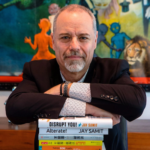
Jay Samit – “Coolest Job,” Video on Demand Creator and Author of Disrupt You!: Master Personal Transformation, Seize Opportunity, and Thrive in the Era of Endless Innovation

Every obstacle out there is actually a new opportunity for an
entrepreneur to create a solution, make life better and profit.
Jay Samit
Jay Samit has been described by Wired magazine as “having the coolest job in the industry.” He is a leading technology innovator who has raised hundreds of millions of dollars for startups, sold companies to Fortune 500 firms, taken companies public, and partnered with some of the world’s biggest brands, including Coca Cola, McDonald’s, General Motors, United Airlines, Microsoft, Apple, Verizon, and Facebook. Samit is CEO of SeaChange International, a leading global multi-screen video software company. A technology innovator and entrepreneur, he was a senior advisor to LinkedIn and was appointed to the White House initiative for education and technology by President Bill Clinton. Samit is the host of the Wall Street Journal Startup of the Year series. Samit helped grow pre-IPO companies such as Linkedin, held senior management roles at Sony and Universal Studios, pioneered breakthrough advancements in mobile video, internet advertising, ecommerce, social networks, ebooks, and digital music that are used by billions of consumers every day. An adjunct professor at USC, Samit teaches innovation at America’s largest engineering school and is author of Disrupt Yourself: Master Personal Transformation, Seize Opportunity, and Thrive in the Era of Endless Innovation. He frequently appears on ABC, Bloomberg, CBS, CNN, Fox, MSNBC, NBC and tweets daily motivation to the over 100,000 business professionals who follow him on Twitter. An expert on transformational corporate change, Samit has been quoted in The New York Times, The Economist, Businessweek, Forbes, Los Angeles Times, USA Today, Fast Company and TechCrunch. He was awarded with the Leonardo Da Vinci Lifetime Achievement Award.